
When the Hype Train Runs Out of Track
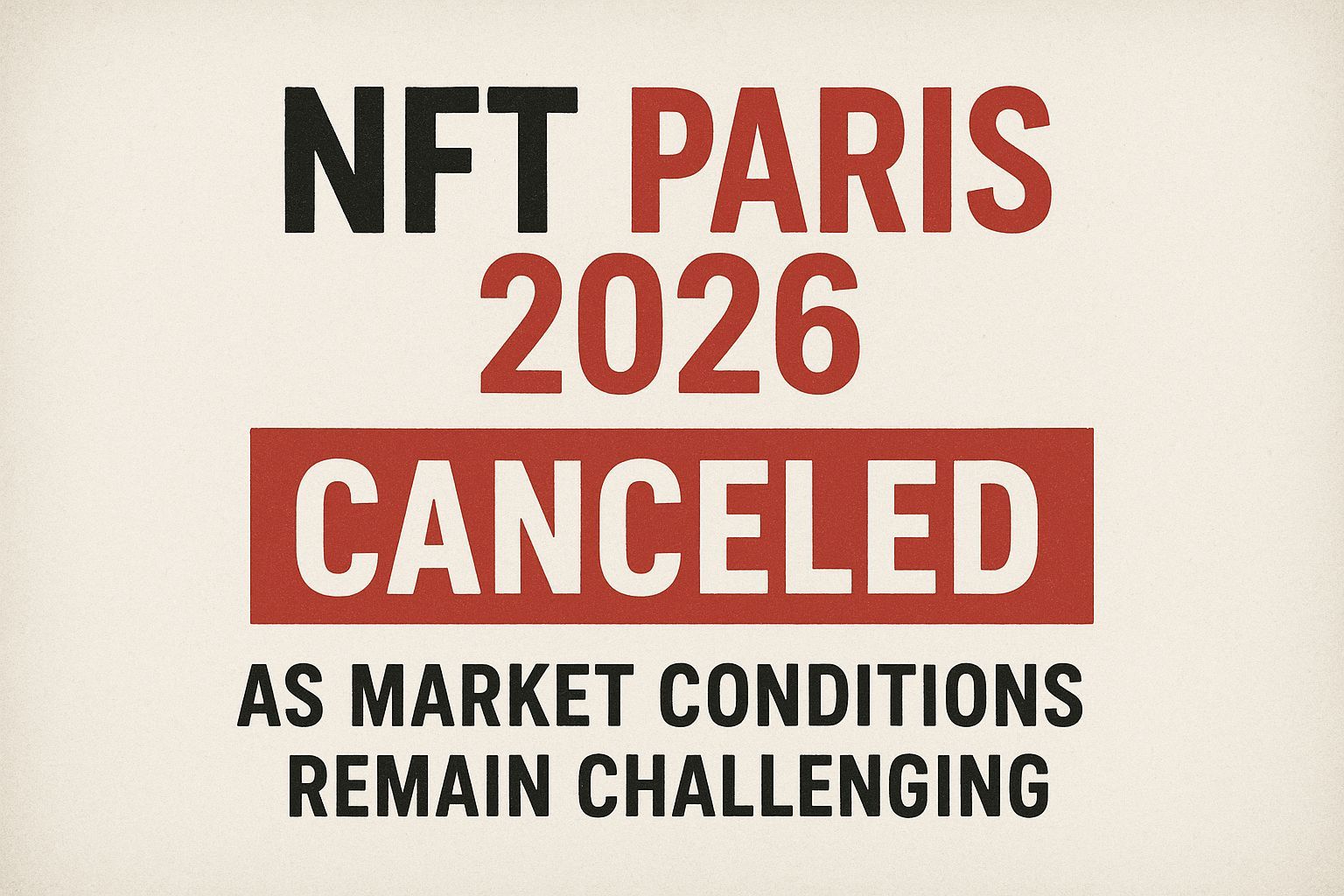
NFT Paris 2026 canceled. RWA Paris scrapped. “Market conditions remain challenging.” That’s not just PR spin - it’s a snapshot of where NFTs really sit in the wider crypto cycle right now.[6][7][9] The flagship European NFT conference, expected to host tens of thousands of attendees and dozens of sponsors, pulled the plug just a month before go‑time, citing a brutal combo: collapsing NFT market, rising costs, exhausted funds, and sponsors now staring at a €500,000 hole with no refunds in sight.[1][3][4][5]
Key Takeaways: What NFT Paris 2026’s Collapse Really Signals
- NFT Paris 2026 and RWA Paris were canceled due to “market conditions,” financial shortfalls, and collapsed sponsor economics.[3][6][7][9]
- Over €500,000 in sponsorship money is reportedly not being refunded, as non‑refundable costs exceeded sponsor payments.[1][3][4][5]
- NFT market cap has cratered ~68% YoY, from about $9B in early 2025 to roughly $2.7B in early 2026, with volumes down ~95% from 2021 peaks.[2][3]
- Ticket holders get refunds; sponsors don’t, exposing a structural risk in event‑driven NFT marketing.[1][3][4][5]
- Core team departures just before the collapse raise governance and legal‑risk questions around Web3 events.[1][3][5]
Subscribe to our Social Media for Exclusive Crypto News and Insights 24/7!
NFT Paris Didn’t Just Stumble - It Hit a Wall
The official NFT Paris site now opens with a blunt statement: NFT Paris & RWA Paris 2026 are cancelled, after “four editions bringing together the global Web3 community in Paris.”[9] Organizers say they “have to face reality”: the event is no longer viable in this market environment.[9]
Announcements across platforms repeat the same framing:
- Market conditions + rising operational costs
- Cost‑cutting wasn’t enough
- The event simply couldn’t proceed as planned[3][6][7][9]
On X and in media summaries, the messaging is consistent:
- All ticket fees will be refunded within 14-15 days.[1][2][3][4][6]
- Parallel events - NFT Paris, RWA Paris, Ordinals Paris, XYZ Paris - are all off the table.[2][3]
Sounds clean on paper. But under the hood, the mechanics are anything but clean.
Follow the Money: €500K Sponsors, Zero Refunds

Here’s where it gets messy - and very “late‑cycle NFT.”
Multiple reports cite sponsors saying they won’t see a cent back of what they paid in.[1][3][4][5][8]
From ChainCatcher coverage and reposts:
- A sponsor, @serc1n, shared an email pointing to Article 12 of their agreement: non‑refundable expenses exceeded total sponsorship fees, so refunds are “impossible.”[1][4][5]
- Okay Bears founder Kais confirmed receiving the same communication.[1][4][5]
- NFT Paris reportedly had 61 sponsors, with packages from €5,000 to over €30,000, totaling over €500,000 in sponsor money now stuck.[1][4][5][8]
One write‑up bluntly notes that sponsors paid for:
- Exposure
- User acquisition
- Brand awareness
- Product sales
And now? “The sponsorship fees are gone.”[5][8]
A ChainCatcher‑quoted comment even goes as far as: if the claim about the core team exiting right before the collapse is true, “this is purely criminal behavior.”[5] That’s an allegation, not a judgment. But it tells you how betrayed parts of the ecosystem feel.
From a market‑structure angle, this is the event‑driven trade blowing up:
- Sponsors bet on narrative + visibility to offset spend.
- The event disappears.
- Their ROI goes straight to zero, but their budget burn is locked in.
Imagine being a mid‑tier NFT platform that cut your 2026 marketing budget in half to appear at NFT Paris… and now it’s just an expensive lesson in counterparty risk.
Macro View: NFT Market Didn’t Correct - It Got Steamrolled

The macro NFT backdrop is ugly, and the numbers in the reports are clear:
- NFT market capitalization dropped from about $9B in January 2025 to just over $2.7B in 2026 - roughly a 68% YoY decline.[2][3]
- Monthly NFT sales slid to around $320M in November 2025 and likely pushed lower in December.[2][3]
- Trading volumes are down ~95% from the 2021 mania peak across major marketplaces.[2]
Collections that once defined the speculative top - Bored Ape Yacht Club, CryptoPunks - have seen valuations sharply down even as fungible tokens have bounced.[2] That’s classic dominance rotation:
- In bull phases, NFTs can outperform as high‑beta bets on culture.
- In stressed phases, liquidity collapses fastest where order books are thinnest and price discovery is narrative‑driven.
NFTs, unfortunately, sit top of that illiquidity food chain.
You’ve seen this movie before:
- 2018 ICO winter after 2017’s blow‑off.
- DeFi token carnage after the 2020-2021 yield mania.
An analyst cited in one of the NFT market summaries compared the 2025 NFT drawdown to “2021’s blow‑off top, but with less exit liquidity and more denial.”[2][3] Rough, but not wrong.
On‑Chain and Market Mechanics: Why Events Like This Get Axed First

If you pull up CoinMarketCap’s NFT sector index or check TradingView charts for leading NFT‑adjacent tokens, you can see the structure: grinding lower highs, fading volumes, and dominance bleeding back to BTC and majors.[2][3]
Mechanically, a few things stand out:
Dominance cycles
- As BTC and ETH dominance creep higher, capital rotates out of long‑tail narratives like NFTs into what traders see as “safer beta.”
- NFT‑linked tokens and ecosystems become funding sources: people sell them to chase higher‑conviction trades.
Trend strength & ADX‑type dynamics
- You don’t even need indicators to see it: weeks of sideways drifting with no follow‑through on NFT “revival” pumps.
- Any breakout attempts in NFT‑related tokens have been met with instant sell‑pressure, consistent with a low‑conviction, trendless environment.
Liquidation and reflexivity
- In 2021, high leverage + NFT collateral + mark‑to‑fantasy valuations meant liquidations amplified upside and downside.
- Now, much of that leverage is gone - but what’s left is post‑liquidation apathy. When floors fall 80-90% and never bounce meaningfully, speculators don’t come back quickly.
One institutional‑style recap of NFT marketplace volumes noted that market depth on major collections has thinned to the point where “any decent‑sized order moves the floor multiple percentage points.”[2] That kind of illiquidity makes it hard to build institutional‑friendly narratives - and without that, big sponsors are more sensitive to every basis point of spend.
Add in rising event costs in Europe, venue pricing, production, compliance, and suddenly a “flagship” NFT conference becomes a leveraged bet on an illiquid sector. When the curve moves against you, there’s just no margin for error.
Platform Pivots: When the Market You Serve Vanishes
Another major theme in the sources: NFT platforms are quietly or loudly pivoting away from pure NFTs.
Examples pulled from recent industry coverage:[2][3]
- OpenSea announced a shift from being purely an NFT marketplace to a broader platform for “tokens, collectibles, culture, and digital and physical items” - a “trade everything” pivot.[2]
- X2Y2 shut down its NFT marketplace operations and decided to pivot toward AI in March.[2]
- Rarible rolled out a redistributive model for active traders in September, admitting prior designs were “not sustainable.”[2]
Analysts commenting on the NFT Paris situation connect these dots:
- The NFT business model - high volumes, high fees, speculative churn - hasn’t held up once volumes dropped 90%+.[2][3]
- Platforms are hedging out pure NFT exposure and trying to catch AI, DePIN, RWA flows instead.
NFT Paris itself was bundling RWA Paris, Ordinals Paris, XYZ Paris (AI + DePIN) into the same conference package.[2][3] That’s not an accident; it’s a narrative diversification play.
And yet, even with that multi‑theme packaging, sponsors still got crushed when the economics broke. One analyst in a market recap put it bluntly:
“If your event revenue model relies on a vertical where volumes are down 95%, no amount of cross‑branding will save you when the tide goes out.”[3]
Governance Red Flags: When the Core Team Bails
More than one report mentions that the core team that had run NFT Paris for three years reportedly left shortly before this blow‑up.[1][3][5]
That raises uncomfortable but necessary questions for serious investors and builders:
- Who’s on the hook when a Web3 brand goes under but has accepted six‑figure sponsor cash?
- How are agreements structured to handle insolvency or “non‑refundable” cost overruns?
- What kind of board, legal, or escrow structures exist - if any - for major ecosystem events?
Sponsors in this case are basically unsecured creditors in a collapsing micro‑economy. They thought they were buying exposure, but what they were really buying was unsecured event risk in a stressed asset class.
An industry commenter quoted by ChainCatcher summed it up:
“This isn’t just about NFTs being down. It’s about Web3 events still running Web2‑startup governance with zero downside protection for partners.”[5]
Hard to argue with that.
So What Now? Is This the Bottom or Just Another Leg Down?
Is NFT Paris 2026 getting canceled the final capitulation or just another step in a slow bleed? That’s the trillion‑dollar question.
Here’s what the data and commentary hint at:[2][3]
- Fundamentals: User counts, volumes, and creator revenues are all far below their peak, but not zero. There’s still a core of real users and builders.
- Infrastructure: Marketplaces, wallets, and standards are more mature than in 2021. Even with pivots, the tooling isn’t going away.
- Speculative premium: That’s what’s been nuked. The “JPEGs as retirement plan” era is over for now.
Historically, these are the conditions where:
- Strong hands quietly accumulate high‑quality assets with genuine cultural or financial utility.
- Tourists leave.
- Narratives reset from “number go up” to “does this actually solve anything?”
An analyst quoted in one of the financial summaries on the NFT downturn framed it like this:
“If 2021 was the blow‑off top, 2025-2026 feels like the long hangover. The builders who remain now are the ones you actually want to underwrite.”[3]
Imagine holding SOL through the 90%+ 2022 drawdown. Brutal. But for some, that period was where the conviction trades were made. NFTs might be entering their version of that phase now - just with way less leverage and way more skepticism.
For Investors: How to Read This Without Overreacting
If you’re thinking about positioning around NFTs or NFT‑adjacent plays after something like NFT Paris 2026 blowing up, a few loose heuristics:
- Treat events and sponsorships as cyclical leverage, not structural value.
- Separate NFT tech (on‑chain identity, gaming items, RWAs) from NFT speculation (10k PFP flips).
- Watch dominance and sector flows - when BTC and ETH dominance start to stall and majors consolidate, that’s usually when capital starts sniffing around the edges again.
- Be allergic to “this time it’s different” pitches that don’t back it with hard on‑chain usage or revenue data.
The whales ain’t sleeping, fam. They’re rotating. They’ve already rotated out of pure NFT exposure. The interesting question is when - not if - they rotate back in, and what they choose: infrastructure, RWA‑backed assets, gaming, or a new cultural meta we haven’t priced yet.
NFT Paris 2026 canceled
NFT market downturn
RWA Paris sponsors
- https://coinmarketcap.com/academy/article/nft-paris-cancels-february-conference-amid-market-downturn
- https://www.binance.com/en/square/post/01-07-2026-nft-paris-2026-event-canceled-due-to-financial-constraints-34747812278898
- https://www.ainvest.com/news/nft-paris-cancels-2026-events-fails-refund-sponsors-involving-500-000-euros-2601/
- https://www.kucoin.com/news/flash/nft-paris-cancels-2026-event-and-refuses-to-refund-over-500-000-in-sponsorships
- https://www.rootdata.com/news/494261
- https://longbridge.com/en/news/271584087
- https://www.coinex.com/feed/news/695c62406fe57b48543fa4d8
- https://www.coinex.network/feed/news/695dd7247776979c5b3fa78e
- https://www.nftparis.xyz






