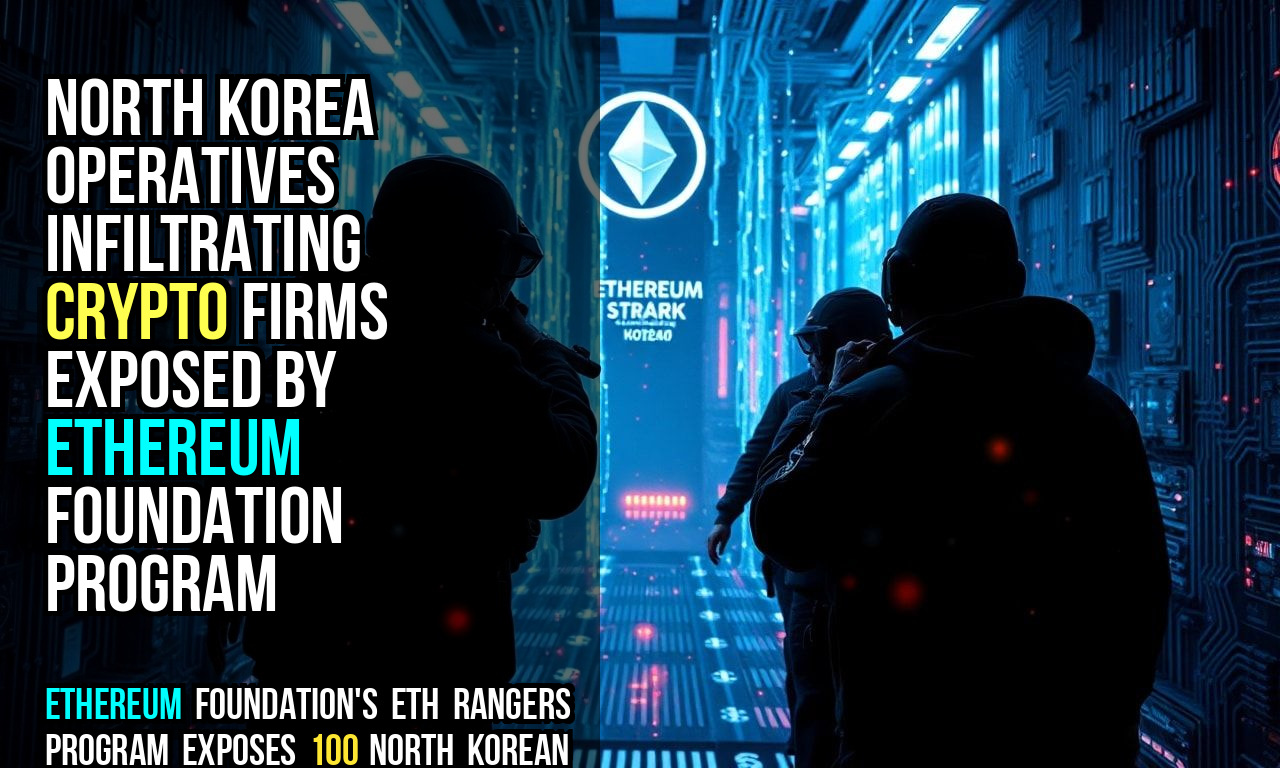
Ethereum Foundation’s ETH Rangers Program Exposes 100 North Korean Operatives in Crypto
The Ethereum Foundation’s six-month ETH Rangers Program concluded in mid-April 2026 by identifying approximately 100 North Korean IT workers embedded across 53 cryptocurrency projects, simultaneously recovering $5.8 million in funds and surfacing 785+ security vulnerabilities across the ecosystem[1][6].
Key Metrics
- Operatives identified: ~100 DPRK-linked IT workers detected across 53 crypto projects globally, operating under false identities[1][2][3]
- Financial recovery: $5.8 million in funds recovered from compromised accounts; hundreds of thousands more frozen by independent investigators[1][6]
- Vulnerabilities surfaced: 785+ security flaws reported across affected projects during the investigation window[1][6]
- Funding source: Ethereum Foundation’s Ecosystem Support Program coordinated research through the Ketman Project and Security Alliance (SEAL)[1][3]
- Detection mechanism: Open-source platform developed to identify suspicious GitHub contributor patterns and behavioral indicators consistent with known DPRK worker profiles[2]
- Attribution: Security analysts connected operations to the Lazarus Group, a state-sponsored North Korean cybercrime organization linked to approximately $7 billion in cumulative cryptocurrency theft since 2017[2]
Subscribe to our Social Media for Exclusive Crypto News and Insights 24/7!
The ETH Rangers Program Structure and Findings
The Ethereum Foundation launched ETH Rangers in late 2024 specifically to target emerging security threats within its ecosystem[3]. The six-month operation funded 17 independent scholars whose work ranged from vulnerability research to threat analysis and incident response[6]. The Ketman Project, one recipient allocation, specialized in identifying “fake developers” operating under fabricated identities within Web3 organizations[6].
Researchers developed a behavioral and technical framework to flag indicators consistent with North Korean IT worker patterns, including GitHub activity anomalies, communication metadata, and identity verification inconsistencies[1][2]. The program notified 53 projects that they likely employed active DPRK-linked agents, triggering immediate incident response protocols across the affected organizations[6].
Blockchain investigator Nick Bax operated independently of the formal program structure, identifying and notifying more than 30 additional project teams of DPRK-linked workers on their active payrolls[1]. This parallel effort coordinated the freezing of hundreds of thousands of dollars already received by these operatives, expanding the total recovery scope beyond the officially reported $5.8 million[1].
Operational Security Threat Assessment

The Ethereum Foundation framed these findings as addressing “one of the most acute operational security threats facing the Ethereum ecosystem today,” explicitly characterizing the infiltration as an ongoing threat requiring active detection infrastructure rather than a resolved historical anomaly[1][6]. This distinction matters: it signals that similar embedded operatives likely remain active across the broader Web3 landscape.
North Korean operatives reportedly gained access through legitimate employment channels while maintaining concealed connections to Pyongyang[3]. These embedded developers frequently demonstrated genuine blockchain development expertise, which allowed them to contribute credibly to protocol development and infrastructure projects while conducting reconnaissance and potentially accessing critical systems[2][6].
The infiltration spans multiple years, with operatives simultaneously earning legitimate salaries while conducting espionage activities[6]. United Nations reports confirm North Korea uses stolen cryptocurrency to fund its weapons programs, circumventing international sanctions through coordinated digital asset theft[3]. The systematic, long-term nature of the operation underscores state-sponsored strategy rather than isolated criminal activity[3].
Attribution and Historical Context
Security analysts connected numerous operations to the Lazarus Group, a state-sponsored North Korean cybercrime organization responsible for major cryptocurrency theft operations[2][6]. Industry calculations estimate North Korean-affiliated entities have successfully stolen approximately $7 billion from cryptocurrency platforms beginning in 2017[2]. This includes significant breaches such as the Ronin Bridge compromise and the WazirX security incident[2].
The timing and sophistication of this infiltration operation suggest institutional-level resource allocation and planning. North Korean IT workers frequently operate from third countries while maintaining command-and-control connections to Pyongyang, making attribution and enforcement substantially more difficult[3].
Regulatory and Industry-Wide Implications

The investigation’s public disclosure has prompted heightened regulatory attention across both crypto organizations and U.S. law enforcement. The U.S. Justice Department announced in the same week that two American nationals had been sentenced to at least seven years in prison for helping DPRK operatives pose as U.S.-based developers to infiltrate approximately 100 domestic companies[1]. This parallel prosecution demonstrates that crypto-sector infiltration represents only one component of a broader state-sponsored employment fraud operation.
State-sponsored infiltration constitutes a different operational threat category than typical cybersecurity breaches. North Korea’s demonstrated strategy could trigger new regulatory hiring protocols, enhanced identity verification requirements, and mandatory background-check frameworks affecting how crypto firms conduct recruitment and onboard developers[4].
Market Perception and Uncertainty
Early market reaction to the infiltration findings introduced measurable uncertainty into forward price expectations. A Bitcoin prediction market tracking the probability of BTC reaching $100,000 by December 31, 2026, moved to 37.5% YES (up from 34% the previous week), though the security revelations themselves created offsetting downward pressure as traders weighed insider threat risks against price trajectory fundamentals[4]. This bifurcated reaction suggests the market acknowledges both the threat’s reality and the possibility that enhanced security protocols could mitigate systemic damage.
The XRP market, tracked separately for the same prediction window, remained at 100% YES for April 15, suggesting limited spillover regulatory concern to non-Ethereum ecosystems at this early stage[4].
Unknown Variables and Data Gaps
Several critical variables remain unconfirmed or partially disclosed:
Scope of undetected operatives: The ETH Rangers program identified 100+ operatives, but no direct data confirms whether this represents the total population of active North Korean operatives within crypto companies or a subset of detected agents. The Ethereum Foundation’s framing suggests ongoing risk, implying additional undetected operatives may remain embedded.
Infrastructure damage assessment: While 785+ vulnerabilities were surfaced, the sources do not quantify how many represented exploited attack vectors versus patched flaws, leaving the actual damage scope ambiguous.
Temporal distribution: No data confirms whether the 100 operatives were simultaneously active during the investigation window or accumulated across multiple years of infiltration activity.
These gaps limit precision in assessing true ecosystem penetration depth or forecasting the effective duration of remediation efforts.
Long-Term Structural Considerations (12-36 Month Horizon)
Looking forward, the disclosed infiltration likely accelerates three structural shifts within crypto infrastructure:
Identity verification infrastructure expansion. Enhanced KYC and background-check protocols for developer hiring will increase operational costs and friction for Web3 organizations, particularly smaller teams lacking dedicated compliance resources. This creates potential competitive advantage for well-capitalized platforms and protocols with robust hiring infrastructure.
Decentralized security monitoring adoption. The success of the open-source detection platform developed during ETH Rangers suggests growing demand for decentralized or community-operated threat-detection systems. This could drive investment and protocol-level infrastructure development around continuous behavioral anomaly detection.
Regulatory tightening around foreign developer hiring. Jurisdictions including the U.S. and EU may introduce restrictions on hiring developers from sanctioned countries or DPRK-connected regions, creating workforce constraints for crypto companies with global developer pools but limited geographic hiring restrictions.
Bottom Line
The Ethereum Foundation’s ETH Rangers investigation confirmed what institutional security teams have suspected: North Korean state-sponsored operatives have systematically embedded within crypto development infrastructure for years, leveraging legitimate technical skills to access systems while conducting espionage and theft. The disclosed recovery of $5.8 million and identification of 100+ operatives across 53 projects represents enforcement success, but the Foundation’s explicit framing of this as an ongoing threat rather than a resolved incident suggests the infiltration problem extends beyond what has been publicly surfaced. Organizations that have not yet implemented rigorous developer identity verification and behavioral monitoring face asymmetric risk exposure in the 12-36 month period ahead, while those with enhanced security protocols have already begun extracting competitive positioning through validated, trustworthy development teams.
[1] https://www.coinspeaker.com/ethereum-foundation-exposed-north-korean-workers-crypto/
[2] https://www.binance.com/en/square/post/313473640888433
[3] https://www.binance.com/en/square/post/313300556555153
[4] https://cryptobriefing.com/ethereum-backed-project-uncovers-100-north-korean-operatives-in-crypto-firms/
[5] https://www.mexc.co/news/1037631
[6] https://forklog.com/en/ethereum-foundation-scholar-uncovers-100-north-korean-it-agents-in-web3-firms/