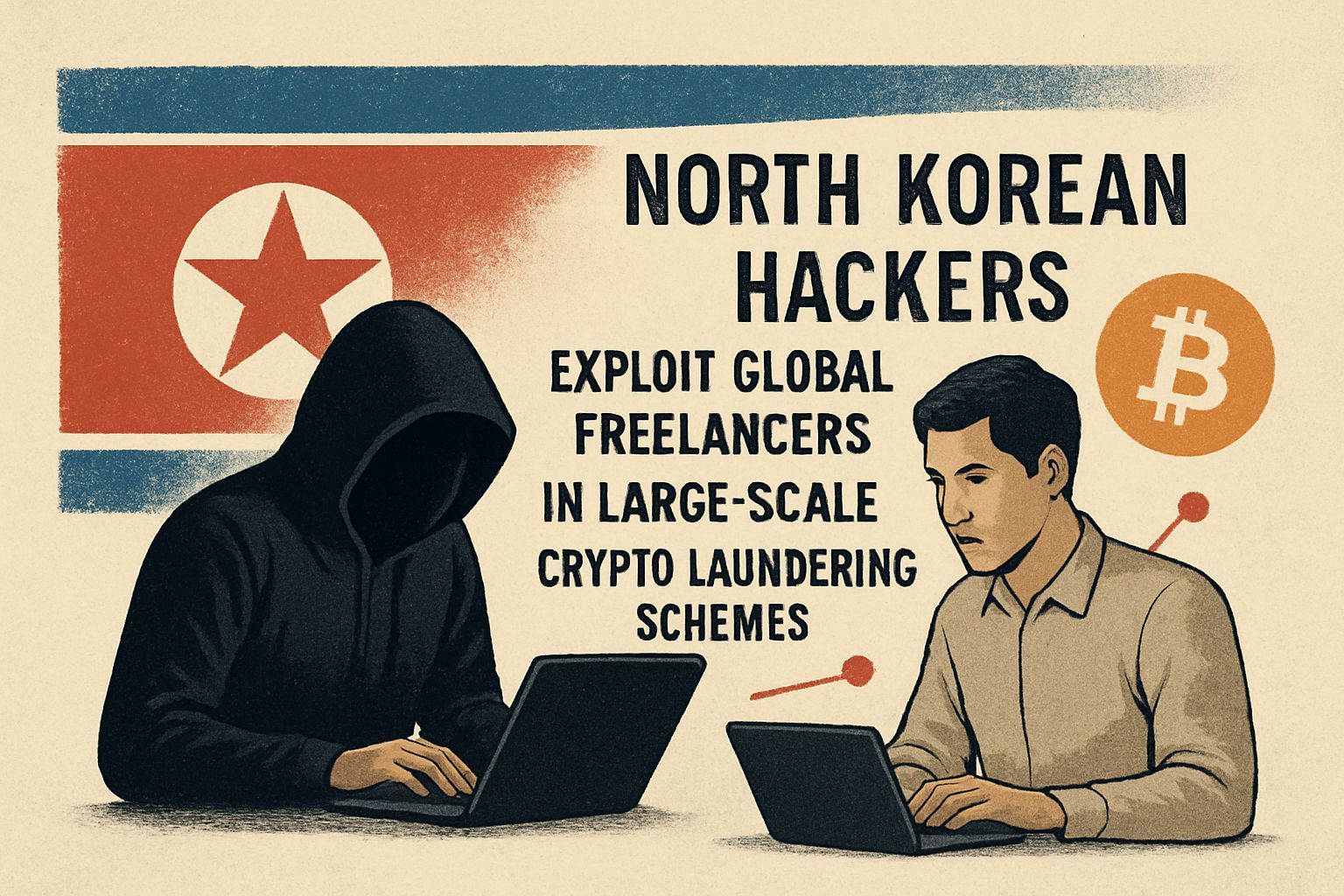
What if your next freelance crypto job is actually funding a secretive hacker operation?
Imagine you’re a freelancer working on a crypto project-seemingly just another remote gig-but little do you realize, you might be playing a small part in a sophisticated North Korean cryptocurrency laundering scheme. Sounds like something out of a thriller, right? Yet, this is exactly what’s been happening on a large scale with North Korean hackers exploiting global freelancers to launder billions of dollars in stolen cryptocurrency.
North Korean hackers, particularly the notorious Lazarus Group, have engaged in large-scale crypto laundering by leveraging global freelancers and IT workers. These tactics not only fuel their regime’s nuclear program but also shake the global crypto market’s confidence and stability. Today, let’s dive deep into how these hackers operate, what it means for crypto investors, and practical ways to stay safe in this murky digital space.
Key Takeaways: ?
Subscribe to our Social Media for Exclusive Crypto News and Insights 24/7!
- North Korean hackers have stolen over $3 billion in cryptocurrencies in recent years, using global freelancers to launder funds.
- The infamous Lazarus Group orchestrated the largest crypto heist by stealing $1.5 billion from ByBit exchange.
- North Korean IT firms exploit overseas freelance workers and fake identities to channel illicit money back to Pyongyang.
- These activities cause volatility and uncertainty in the crypto market, impacting investor confidence.
- Practical tips include rigorous due diligence on crypto projects, verifying freelancer identities, and keeping up with regulatory developments.
?️️ How North Korean Hackers Exploit Freelancers for Crypto Laundering
The infamous Lazarus Group, acting as a cyber army for North Korea’s government, has evolved its tactics beyond straightforward hacks. After stealing significant cryptocurrency amounts-over $3 billion since 2007-they need sophisticated laundering schemes to legitimize their gains[1][3][4].
One lesser-known but ingenious ploy involves recruiting or co-opting global freelancers and IT workers who are oblivious to their roles in laundering schemes. North Korean IT companies, like Korea Mangyongdae Computer Technology Company (KMCTC), dispatch worker delegations and collaborate with foreign freelancers on crypto-related projects. These freelancers operate independently, but funds generated from their gigs are partially funneled back to North Korean fronts, laundered through financial institutions with deep links to the regime[2][3].
To hide these transactions, North Korean financial institutions use a web of proxies across China, Russia, and elsewhere to obscure the money trail. Cryptocurrency wallets tied to these entities show patterns similar to salary payments, though they disguise illicit earnings from cybercrime and fraudulent IT operations[2]. This blend of legitimate freelance work and covert laundering creates a nearly invisible veil over the flow of stolen crypto.
? The ByBit Hack: North Korea’s Biggest Crypto Heist Ever

If you think hacking is mostly about tech geeks in dark rooms, the ByBit attack on February 21, 2025, shows otherwise. Lazarus Group stole a staggering $1.5 billion in Ethereum tokens, using a combination of phishing attacks and exploiting storage software weaknesses on the Dubai-based ByBit exchange[1].
Within just 48 hours, about $160 million of those stolen funds were laundered, quickly dispersing throughout the global crypto ecosystem to evade detection[1]. While ByBit doesn’t operate in the US, the crisis spooked global investors, triggering a 20% drop in Bitcoin’s price from its January peak, highlighting the fragility of trust in decentralized finance.
This massive theft is more than a headline-it’s a concrete example of how cybercriminals leverage technical vulnerabilities and global networks (including unsuspecting freelancers) to fuel an entire state’s nuclear ambitions under the radar.
? The Broader Impact on the Crypto Market
Let’s talk shop-what does this North Korean hacking and laundering saga really mean for crypto investors and the market?
Increased Volatility: Large-scale thefts like the ByBit hack rattle market confidence, leading to sharp price fluctuations that hurt both long-term holders and short-term traders[1].
Heightened Regulatory Scrutiny: Governments, especially in the US, are doubling down on crypto regulations to curb illicit activities. These moves may slow down innovation but aim to strengthen user protections[1][4].
Fraud Risks in Freelance Crypto Work: As North Korean hackers disguise illicit laundering through freelancing platforms, legitimate freelancers and projects may unintentionally become mired in regulatory or legal issues. This risk adds a layer of uncertainty for investors backing new crypto ventures employing freelance talent[2].
Threat to Global Security: The financial proceeds from crypto crimes fund North Korea’s nuclear weapons programs, which increases geopolitical risks. This backdrop can affect crypto market sentiment, as global tensions influence risk-on or risk-off investment behavior[2][3].
As a crypto analyst chatting with you over coffee, I’d say these developments remind us how interconnected crypto markets are with geopolitics and cybersecurity. Vulnerabilities in one nation or platform ripple across the globe instantly.
? Practical Tips: How to Protect Yourself and Your Investments

Even in this complex web of hackers and laundering, there are smart moves you can make to protect your crypto future:
Do thorough due diligence on any freelance or crypto project you engage with. Check if there are red flags, such as unverifiable workers or suspicious financial flows.
Verify identities carefully when hiring freelancers, especially for crypto-related technical tasks. Some may be fronts or unknowingly involved in laundering.
Stay updated on regulatory news and sanctions. Governments like the US Treasury sanction entities and individuals linked to crypto laundering, which you can use as a warning sign[2][4][5].
Use trusted exchanges and wallets. Stick to platforms with strong security and compliance records to minimize hack risks.
Be cautious in Universal Investments. Volatile markets post-hacks are tempting for quick gains but come with heightened risk due to uncertainty.
? My Take: Why This Matters for Your Crypto Journey
Honestly, it’s a bit unnerving to think that your freelance gig or crypto investments could be indirectly aiding a regime’s most secretive operations. But this reality also signals the resilience and complexity of the crypto ecosystem. The hackers’ sophistication reminds us that crypto isn’t just mathematical code-it’s fundamentally about people, politics, and power.
Crypto investors need to sharpen their lenses, viewing every project and freelancer through a prism of risk intelligence. The line between legit work and unwitting complicity in laundering is thinner than ever. Yet, with carefully honed knowledge and vigilance, you can navigate this space profitably and ethically.
As wild as it sounds, the crypto market’s future depends as much on geopolitical vigilance as on blockchain innovation-and this hybrid dynamic makes it an intriguing, if volatile, frontier.
Are you ready to dig deeper into every freelancer or crypto project that crosses your path? The age of decentralized finance demands decentralizing our trust and skepticism too.
North Korean hackers exploit global freelancers in large-scale crypto laundering schemes
North Korean crypto laundering schemes
Lazarus Group crypto theft
Sources:
[1] https://www.csis.org/analysis/bybit-heist-and-future-us-crypto-regulation
[2] https://thehackernews.com/2025/11/us-sanctions-10-north-korean-entities.html
[3] https://cyberscoop.com/north-korean-companies-people-sanctioned-for-money-laundering-from-cybercrime-it-worker-schemes/
[4] https://home.treasury.gov/news/press-releases/sb0302
[5] https://www.occrp.org/en/news/us-sanctions-north-korean-bankers-it-fronts-in-3-billion-crypto-theft-scheme
[6] https://www.icba.org/newsroom/newswatch-today/2025/11/05/treasury-sanctions-north-korean-institutions-involved-in-cybercrime