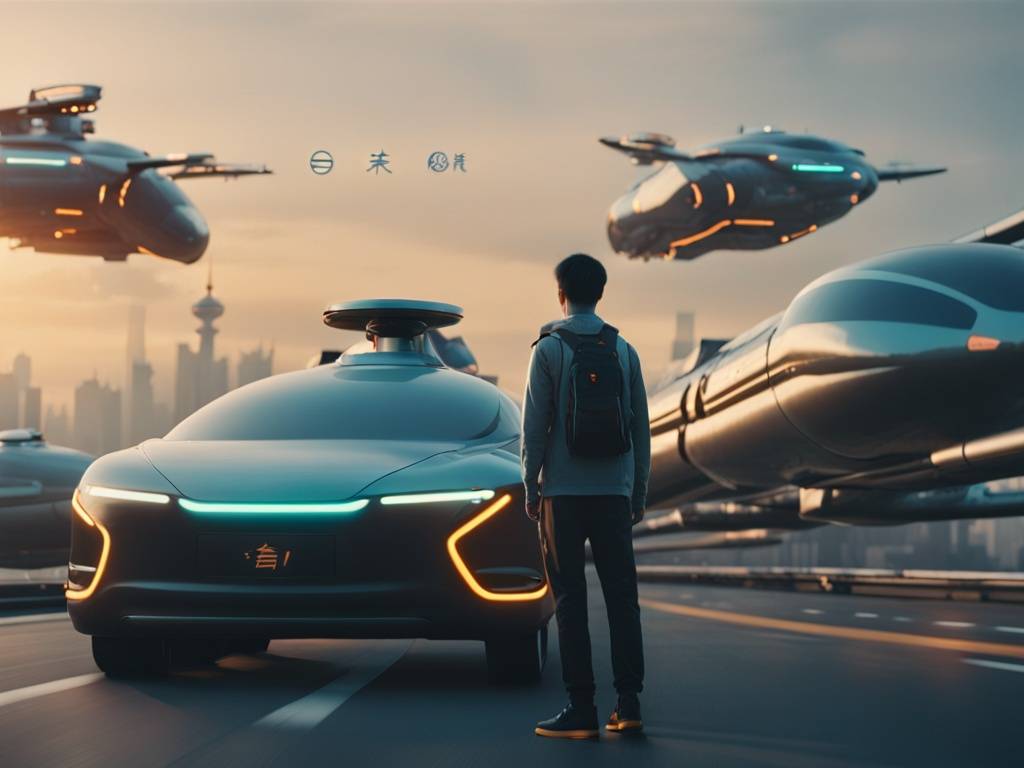
Transforming Mobility: How DeepSeek’s AI is Reshaping China’s Transportation Landscape ?
This year, DeepSeek’s artificial intelligence (AI) technology stands at the forefront of innovation in China’s transportation sector, influencing both electric vehicles and e-scooters. Major brands are increasingly adopting this AI, promising advancements in autonomous driving, safety enhancements, and improved user interaction. This discussion will delve into the various facets of this transformation.
Accelerated Adoption of AI in Transportation: Major Automakers Align with DeepSeek ?

China has positioned itself as a leading innovator in the electric transportation industry in recent years. Underpinning this progress is DeepSeek, a technology firm based in Hangzhou that is considerably expanding its influence beyond electric cars to include e-scooters.
Subscribe to our Social Media for Exclusive Crypto News and Insights 24/7!
DeepSeek’s AI integration is reshaping the market landscape, garnering interest from both established automotive giants and newer micromobility manufacturers.
Recent reports indicate that over a dozen Chinese car manufacturers, including industry stalwarts like BYD, Geely, Great Wall Motor, Chery Automobile, and SAIC Motor, have expressed their intention to incorporate DeepSeek’s AI technology. Start-ups like Leapmotor are also in on the action.
BYD, a sector leader, plans to integrate DeepSeek’s technology into its Xuanji software platform, facilitating advanced autonomous driving functionalities without imposing extra costs on consumers. This shift symbolizes a significant leap towards democratizing assisted driving technology, making it more available to the public.
Currently, around 20 models, such as the popular Seagull sedan-priced at roughly 69,800 yuan (approximately 9,575 dollars)-will benefit from this integration. This widespread adoption strategy could significantly sway the automotive market, encouraging other companies to follow suit.
E-Scooter Revolution: DeepSeek’s AI Takes Center Stage ?
In tandem with the automotive sector, the e-scooter industry in China is undergoing a notable evolution thanks to DeepSeek. Prominent firms like Segway-Ninebot and Niu Technologies are integrating AI into their electric scooters.
Ninebot, backed by Xiaomi, has committed to embedding DeepSeek’s AI technology in its scooters. This initiative aims to improve user interaction through data analytics, AI-driven content generation, and personalized recommendations.
Similarly, Niu Technologies will implement DeepSeek’s advanced language models starting February 9, 2025, planning to utilize this tech for various features, including:
- Advanced driver assistance systems
- Enhanced security functionalities
- Voice-enabled user interactions
- Smart vehicle maintenance tips
Yadea Group, the largest global producer of two-wheeled electric vehicles by sales, joins this innovative wave, signaling plans to incorporate DeepSeek’s AI into its offerings.
DeepSeek’s Surge and Future Mobility in China ?
The swift and extensive adoption of DeepSeek’s AI has prompted analysts to coin the term “DeepSeek fever” within the mobility sector. A keystone of this technology’s success is its cost-effectiveness and efficiency.
DeepSeek’s open-source AI models, such as DeepSeek-V3 and DeepSeek-R1, function at significantly lower operational costs and computing demands compared to traditional advanced language models.
Phate Zhang, founder of data provider CnEVPost, states that vehicles lacking DeepSeek’s technology risk losing market share or even becoming obsolete. This sentiment underscores the escalating role of AI in both the automotive sector and electric mobility.
Meanwhile, DeepSeek’s growth within the e-scooter industry coincides with a burgeoning demand for these vehicles on the international stage. Recent customs data indicates that the value of e-scooter exports surged by 27.6% in 2024, amounting to 5.82 billion dollars, with a notable 47% rise in export volume to 22.13 million units.
DeepSeek’s collaborative model bolsters the spread of AI technology, utilizing platforms like GitHub to enhance model optimization and security. This open development approach empowers companies to hasten the integration of AI, fine-tuning the training and deployment of advanced language models.
Zhang Yongwei, general secretary of China EV100, anticipates that by 2025, around 15 million vehicles in China-equivalent to two-thirds of annual sales-will be outfitted with preliminary autonomous driving systems. This projection illustrates the vast transformation that AI integration is catalyzing within the transportation sector.