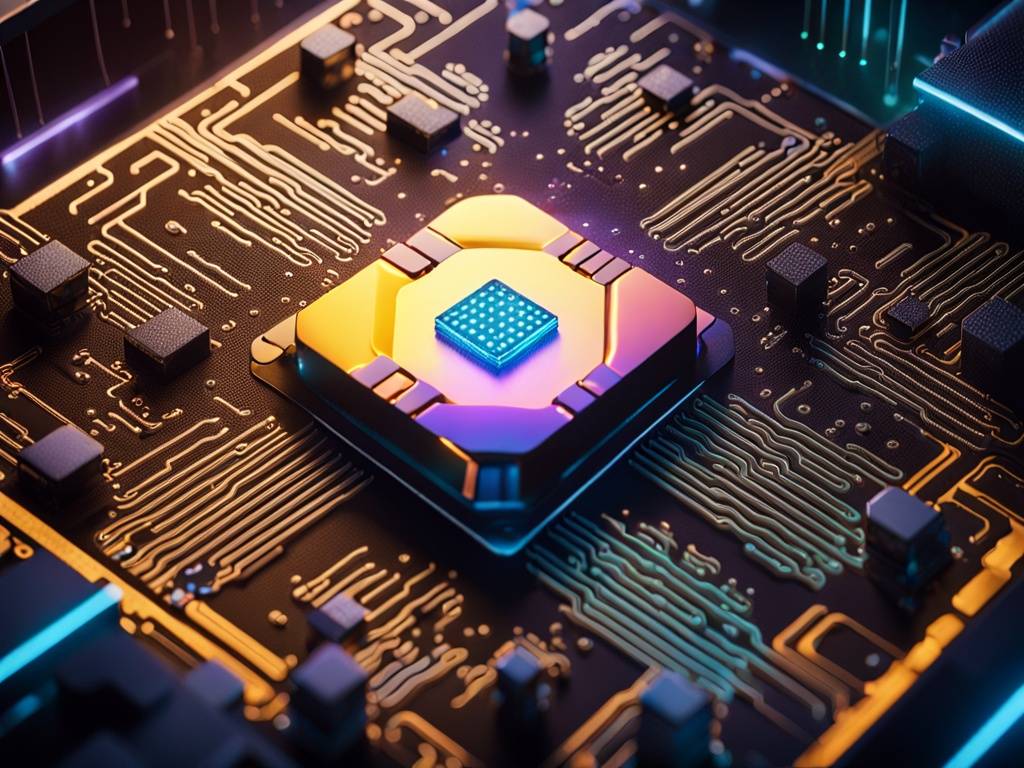
Microsoft’s Quantum Chip Breakthrough: Majorana 1! ?
The tech industry leader, Microsoft, has recently introduced Majorana 1, a groundbreaking quantum chip aimed at transforming multiple sectors of work. This innovative hardware is built on a new state of matter, promising rapid advancements in the development of practical quantum computers and enhancing ultra-fast computing capabilities within AI systems.
Analysts are optimistic about the effect of Majorana 1 on business, positing that it could propel MSFT shares toward the $500 mark.
Majorana 1 Quantum Chip Unveiled by Microsoft
Subscribe to our Social Media for Exclusive Crypto News and Insights 24/7!

In a significant announcement, Microsoft’s CEO, Satya Nadella, introduced the Majorana 1 quantum chip, a major leap in supercomputing technology. The chip utilizes an architecture based on topological superconductors, a novel state of matter that enhances the stability of qubits and minimizes errors.
The innovation hinges on Majorana fermions, particles that exhibit dual characteristics of matter and antimatter, giving the chip its unique name. Nadella emphasized that this technology’s launch aligns with Microsoft’s objective of creating an industrial-scale quantum computing system capable of addressing advanced problems that conventional computers cannot resolve. He noted that while practical quantum computers are still in development, breakthroughs could be within reach in the coming years.
The Transformative Potential of Quantum Computing in AI ?
Quantum chips, such as the Majorana 1, present significant advantages for the artificial intelligence domain, revolutionizing model training and implementation. Currently, AI predominantly relies on GPU and TPU processors to manage large data volumes. In contrast, quantum computers have the potential to exceed these traditional mechanisms, delivering exponential increases in processing speed.
Quantum algorithms will accelerate neural network training, significantly shortening the time needed for data analysis- a vital factor in improving complex model accuracy. Moreover, Quantum Machine Learning (QML) can enhance deep learning methodologies to yield more efficient models that consume less energy. The innate properties of qubits, like superposition and entanglement, enable quantum computers to simultaneously manage numerous variables, thus refining the learning process and leading to more capable AI systems.
One major challenge facing contemporary AI is the “black box” issue, impeding understanding of decision-making mechanisms within models. Quantum computing can address this by providing greater transparency in deep learning models, enabling more intricate analyses without diminishing understanding. This improvement could significantly bolster trust, particularly in critical sectors such as healthcare and finance, where reliability and ethical considerations are paramount.
Aiming for Quantum AI-as-a-Service Integration ?
Microsoft’s strategy includes the integration of Quantum AI-as-a-Service via Azure Quantum, setting the stage for a competitive advantage against tech giants like Google and IBM. As quantum AI becomes more accessible, it is expected to lead to exceptionally optimized systems capable of tackling problems that seem insurmountable today. If scalability is achieved for quantum chips, AI will enter a transformative age, where systems will not only perform faster and more powerfully but also become more comprehensible and responsible.
Market Perspectives: MSFT Stock’s $500 Ambition ?
Experts suggest that the launch of quantum chips by Microsoft could herald a new upswing for the corporation’s stock. The trajectory of developing quantum computers promises numerous business opportunities within the cloud sector, opening doors to future revenue streams that currently do not exist. This scenario could act as a bullish catalyst for MSFT shares, which are already positioned as the second largest by market capitalization.
Despite the potential, the market has yet to fully recognize the implications of this development, with Microsoft shares having only experienced a slight gain during recent trading sessions. Currently, there are concerns over possible declines as the stock nears its 50-week exponential moving average, following a downward trend. Should the price dip below $400, a liquidity sweep around the $380 level may occur.
Regardless of immediate fluctuations, the innovation surrounding the quantum chip signifies a new value driver for Microsoft, likely boosting its stock price over time. Analysts project that within months, the stock may achieve new peaks with estimates reaching as high as $650, indicating a potential appreciation of 55% from present levels.
For more information, consider exploring these key aspects: