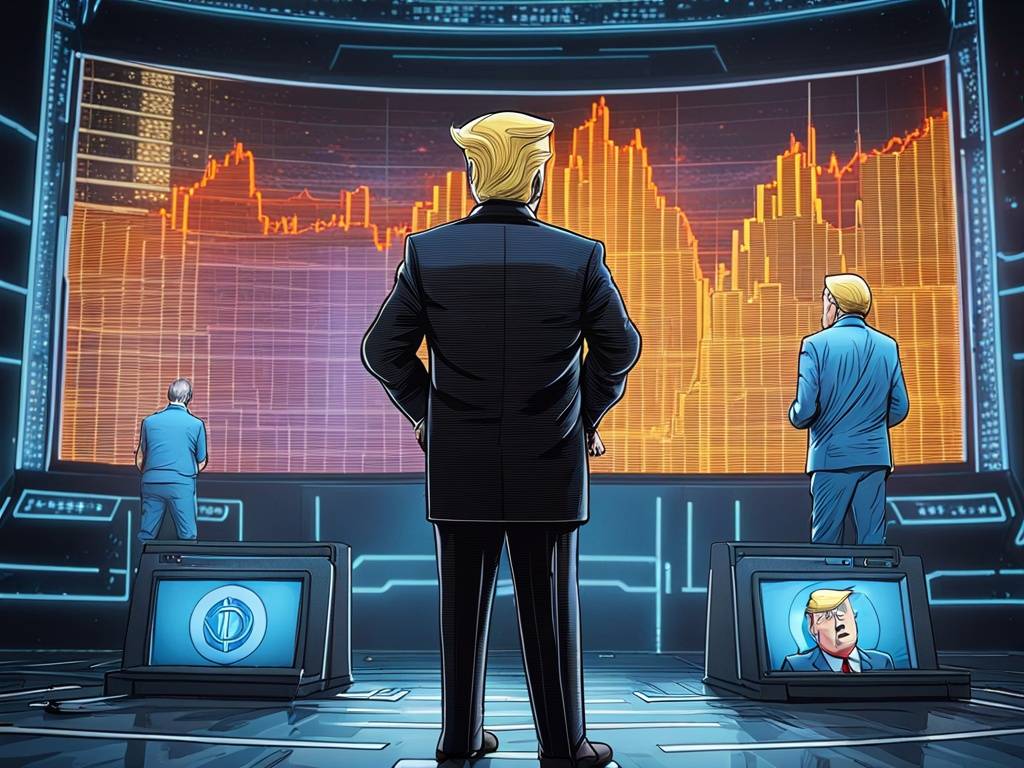
Impacts of Trump’s Economic Policies on the Crypto Market ??
Donald Trump’s electoral triumph over Kamala Harris has been perceived by many in the cryptocurrency community as a significant milestone for the sector. His administration’s favorable approach towards cryptocurrency raised hopes for legislation that would benefit Bitcoin and other digital currencies. Thus far, some of those expectations have materialized. However, a new wave of economic policy is causing disruption-not directly related to the cryptocurrency sector, yet still influencing the marketplace. Trump’s recent tariffs on aluminum and steel have rippled throughout the global economy, impacting crypto assets as well. As a result, investors are now questioning whether these economic strategies are advantageous or detrimental to their interests.
Trump’s Tariffs Impact Global Blockchain Markets ??
On February 9, the Trump administration enacted a notable decision by imposing a 25% tariff on aluminum and steel, affecting a range of nations involved in importing and exporting these materials.
Subscribe to our Social Media for Exclusive Crypto News and Insights 24/7!
According to the Global Steel Trade Monitor published by the International Trade Administration:
- The primary steel exporting countries to the U.S. comprise Canada, Brazil, Mexico, South Korea, Russia, Japan, Germany, Turkey, Vietnam, and Taiwan.
- Leading importers of U.S. steel are Canada, Mexico, China, Italy, India, Belgium, Malta, Brazil, Germany, and South Korea.
Crypto Market’s Response to Economic Changes ?️

Following the tariff announcement, the cryptocurrency market experienced a slight decline in its overall market capitalization, dropping by 0.32%. Nevertheless, it managed to recover by 0.64% the following day.
Even though there was a rebound, the confidence of investors remains lackluster. The Crypto Fear and Greed Index fell from 46 to 43, indicating that the recent recovery did not sufficiently reassure traders.
Price Adjustments in Bitcoin and Ethereum ??
Bitcoin demonstrated this market uncertainty through its price behavior:
- Between February 8 and 9, Bitcoin’s value dipped by 0.040%, reaching a low of $94,715.39.
- Currently, Bitcoin appears to have made some gains, rising by 0.51% today.
Ethereum mirrored this price fluctuation as well:
- Yesterday, Ethereum experienced a decrease of 0.20%.
- Today, it rebounded by just 0.12%, still not fully recovering from its earlier losses.
Tariff Decisions Stir Market Uncertainty ️?

Trump’s tariff announcements have historically led to market upheavals. Here’s a timeline of recent measures:
- February 1: A 25% tariff on imports from Canada and Mexico, along with a 10% tariff on China, was rolled out.
- February 3: The tariffs imposed on Canada and Mexico were momentarily suspended.
- Simultaneously, tensions between the U.S. and China escalated, as China retaliated with a 15% counter-tariff on selected U.S. goods.
This temporary suspension on Canadian and Mexican tariffs is limited to 30 days, hinting at the possibility of reimplementation.
Ongoing Struggles in the Crypto Sector ??
The recent volatility in the cryptocurrency market embodies the unpredictability linked to these trade regulations:
- February 1: The market capitalization was approximately $3.45 trillion.
- February 2: It plummeted to $3.19 trillion.
- February 3: A minor recovery occurred, bouncing back to $3.29 trillion.
- February 4-7: Another downturn took place, lowering the market cap to $3.09 trillion.
- Currently: The market cap is around $3.12 trillion, still in the recovery phase.
Potential Future Volatility in Crypto Markets ??
Reports indicate the Trump administration may extend similar tariff measures to semiconductors, oil, gas, and copper-sectors that could indirectly influence crypto mining operations and infrastructure. There are also speculations suggesting that the European Union might become the next target for tariffs.
If Trump continues with this approach, expect further tumult for the crypto markets in the upcoming months, particularly concerning Bitcoin and Ethereum.
Hot Take ??
The current landscape reveals a complex interplay between traditional economic policies and their unforeseen consequences on the cryptocurrency market. As the world watches these developments, it remains crucial for investors to stay informed and evaluate the implications of these economic decisions on their strategies.