
How Smart Money Quietly Builds Positions: Decoding Accumulation Zones in Crypto Markets
When the Whales Stop Sleeping
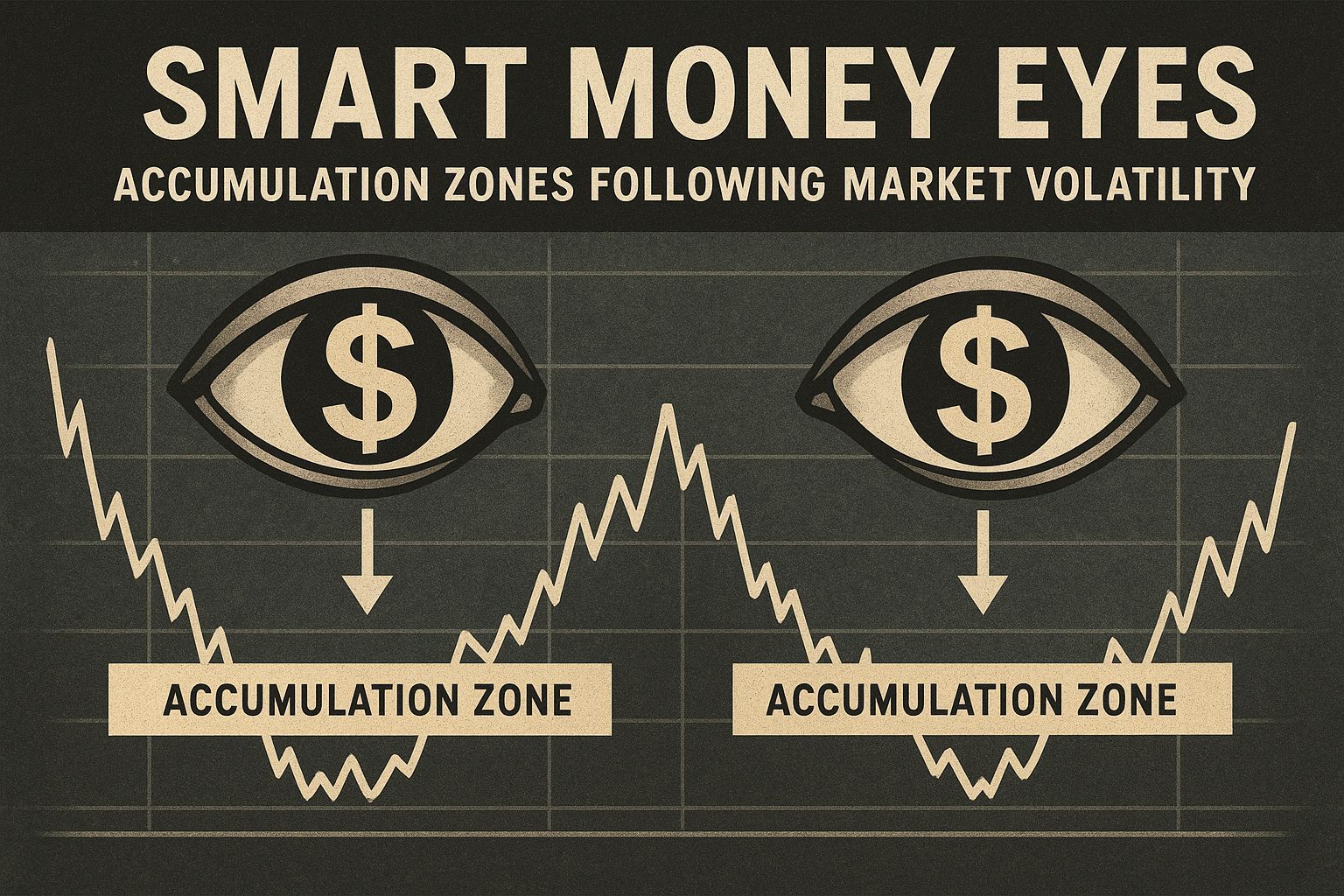
Smart money doesn’t announce itself. It whispers through price action, volume patterns, and on-chain movements that most retail traders completely miss. While the broader crypto market swings wildly on sentiment and headlines, institutional investors are methodically building positions in carefully identified accumulation zones-and if you know where to look, you can spot exactly when it’s happening[1][2][3].
The game here is simple but brutal: smart money accumulates quietly during periods of high volatility and fear, then rides the inevitable price recovery when retail finally catches on. But here’s the thing-they’re not doing this blindly. They’re following a playbook that’s been refined over decades, and understanding that playbook is the difference between trading with them and trading against them[2].
Subscribe to our Social Media for Exclusive Crypto News and Insights 24/7!
Key Takeaways: What You Need to Know Right Now
- Shrinking volatility after downtrends signals genuine accumulation-when price ranges tighten and daily swings compress, smart money is quietly absorbing sell orders[3]
- Support levels that get tested repeatedly but hold firm are institutional magnets where large orders cluster[3]
- Volume dries up during accumulation phases, which seems counterintuitive but actually signals that sellers have been exhausted[3]
- Smart money wallets show measurable accumulation signals through netflows, exchange outflows, and stablecoin positioning[1]
- The Wyckoff method remains a gold standard for identifying when institutions are building positions before markup phases[2][7]
The Anatomy of Smart Money Moves: Breaking Down the Accumulation Phase
Here’s what’s wild about accumulation zones-they look boring. Seriously. After violent downtrends that shake out retail traders, the price action suddenly gets tight. Ranges narrow. Volatility compresses. To the untrained eye, nothing’s happening. That’s exactly when smart money is most active[3].
Shrinking volatility is the first red flag that something’s different[3]. After the wild swings that characterize panic selling and capitulation, the market suddenly finds equilibrium. Daily candles get shorter. Support levels form. And each time price dips to test that support, a fresh wave of buying absorbs every sell order. It’s not aggressive. It’s patient. It’s surgical[3].
Think of it like this: imagine you’re watching a compressed spring. The tighter it gets, the more energy it’s storing. That’s an accumulation zone.
The second signal? A support level that just won’t break[3]. Smart money sets these up intentionally. They establish a clear price floor-maybe a round number, maybe a previous swing low-and then they defend it relentlessly. You’ll see price test that level repeatedly, sometimes five, six, even ten times. Each test gets rejected sharply, often with long lower wicks on candles. Those wicks? That’s smart money saying “nope, not selling here”[3].
The kicker is volume behavior. Counterintuitively, genuine accumulation zones dry up in terms of trading volume[3]. Why? Because the sellers have been exhausted. Retail got panic-liquidated during the downtrend. The remaining holders are either diamond-handing or already underwater. Smart money doesn’t need volume to move price when there’s no real supply to overcome[3].
Following the Money: On-Chain Signals That Institutions Are Buying
You want to know what separates the pros from the amateurs? Pros don’t just look at price charts. They follow the actual movement of assets on the blockchain[1].
Smart Money Wallet Netflow is one of the clearest signals[1]. When you track wallets classified as smart money, you’re literally watching their buying and selling decisions in real time. A sustained positive netflow-meaning more assets flowing into these wallets than out-signals that experienced investors are accumulating. When it’s negative, they’re taking profits or repositioning. It’s that straightforward[1].
But here’s where it gets interesting. Exchange netflows tell an even bigger story[1]. When smart money moves assets off centralized exchanges and into cold storage or self-custody, that’s a screaming signal of conviction. They’re not holding on an exchange where they can be liquidated or tempted to swing-trade. They’re locking it down for the long haul[1].
Then there’s stablecoin positioning[1]. Watch when large stablecoin inflows hit exchanges from smart money wallets. That USDT or USDC isn’t just sitting there-it’s ammunition. It’s ready capital waiting to deploy. Substantial stablecoin inflows from institutional players frequently signal that they’re about to go on a buying spree. Conversely, stablecoin outflows might signal they’re cashing out profits or moving dry powder somewhere else[1].
The circulating supply metric is almost absurd in its simplicity, but it works: when smart money wallets control an increasing percentage of the circulating supply, it indicates growing confidence and concentrated ownership-and that concentration often precedes upward price momentum[1].
The Wyckoff Method: The Blueprint Smart Money Actually Uses

Want to know how serious traders identify accumulation? They use the Wyckoff Accumulation Theory, a framework that’s been adapted from traditional markets straight into crypto[2][7]. And honestly, once you see it on a chart, you can’t unsee it.
The Wyckoff process outlines four distinct market phases: accumulation, markup, distribution, and markdown[2]. Each phase has its own characteristics, and recognizing them helps you position before the big moves happen[2].
The accumulation phase is where the magic starts. It’s characterized by sideways price movement, often following a downtrend. This sideways action can stretch for weeks or even months, and that’s when smart money is feeding like sharks in chum-filled waters[2].
The structure follows this sequence:
Selling Climax kicks things off-prices drop sharply, panic selling hits, and retail holders capitulate[2]. It’s violent, it’s emotional, and it’s exactly what smart money is waiting for[2].
Then comes the Automatic Rally, where prices rebound as fresh buyers step in[2]. This is the bounce that tricks retail into thinking it’s the start of a bull run. Spoiler alert: it’s not. It’s just the beginning of the setup.
The subsequent phases-Secondary Test, Spring, and Last Point of Support-all offer traders critical signals about future price movements[2]. Each one tests lower but with progressively less selling pressure[2].
The key to spotting this on live charts? Watch for sideways price movement after a downtrend, increased trading volume during pullbacks, and the presence of support levels that get tested repeatedly[2]. Volume behavior is crucial-high volume on up days inside an accumulation zone signals that smart money is actively buying[7].
Order Blocks: Where Institutional Orders Actually Live

There’s a concept in smart money trading called order blocks, and it’s basically the exact price level where institutions are clustered and waiting[6]. An order block consists of several parts:
The origin candle is the final bearish candle before a bullish move (or vice versa in bearish zones)[6]. This candle represents institutional absorption-smart money is filling positions while the public is still trading in the wrong direction[6].
When price moves away from that order block, you see displacement-swift, one-sided moves with long candle bodies and minimal wicks[6]. That’s when you know institutions have committed capital. It’s the moment the spring releases[6].
The imbalance created by this displacement creates a vacuum that price often returns to fill. Smart money knows this. They’re banking on it[6].
The Liquidity Hunt: How Smart Money Sets Traps
Here’s something that’ll make your stomach turn once you see it: smart money doesn’t just buy support levels. They manipulate them to trigger retail stop-losses[3].
Institutional traders identify obvious liquidity zones-clean horizontal lows, the bottom of well-defined ranges, places where everyone is watching[3]. These are exactly where retail traders cluster their stop-loss orders. And then smart money does something brilliant: they push price down just far enough to take out those stops, knowing full well they’re about to turn around and buy aggressively[3].
You see it as a liquidation cascade. They see it as a fire sale[3].
The confirmation comes when you spot higher lows forming within a broader sideways range-a quiet signal that buyers are getting more aggressive[3]. Combined with fading volume, this is institutional positioning 101[3].
Real-World Mechanics: Why This Actually Matters
Accumulation zones aren’t theoretical. They’re where the actual big money is made[4]. In crypto, major bottoms often follow a predictable sequence:
Capitulation first-forced sellers panic and exit, creating the left shoulder of a head-and-shoulders pattern[4]. Max fear comes next-the head during panic selling or liquidity stress when sentiment hits rock bottom[4]. Then comes the quiet accumulation phase-the right shoulder-where value buyers step in and price stabilizes[4].
The beauty of this pattern? It signals a trend reversal into a new uptrend. It works across multiple timeframes, from 4-hour to weekly charts[4]. Once that pattern completes and price breaks out with roughly double average volume, you’re looking at extended upside moves[4].
The Bottom Line: Patience Beats Panic Every Time
Smart money makes money because they’re patient. They don’t chase. They don’t panic. They sit in accumulation zones, watch volume dry up, watch support hold firm, and wait for the rest of the market to catch up. When volatility compresses enough and support holds enough times, the markup phase begins-and that’s when retail finally notices what institutions have been doing all along[2][7].
If you’re serious about trading with institutional flow instead of against it, start tracking smart money wallets[1]. Watch for support levels that get tested repeatedly[3]. Notice when volume dries up after downtrends[3]. And when you see displacement-that swift, one-sided move away from a support level with expanding volume[6]-that’s your signal that the smart money is moving, and the next phase is beginning.
The whales ain’t sleeping, fam. They’re rotating. And now you know where they’re doing it.
- https://www.nansen.ai/post/smart-money-indicators-key-metrics-for-cryptocurrency-accumulation-investor-behavior-analysis
- https://www.osl.com/hk-en/academy/article/how-to-apply-the-wyckoff-accumulation-theory-to-trade-crypto
- https://www.colibritrader.com/accumulation-manipulation-distribution/
- https://www.westafricatradehub.com/crypto/crypto-chart-patterns/
- https://www.youtube.com/watch?v=wC4ZavkzDU4
- https://liquidityfinder.com/news/anatomy-of-a-valid-order-block-in-smart-money-concepts-67221
- https://bookmap.com/blog/wyckoff-trading-strategy-understanding-market-cycles






