
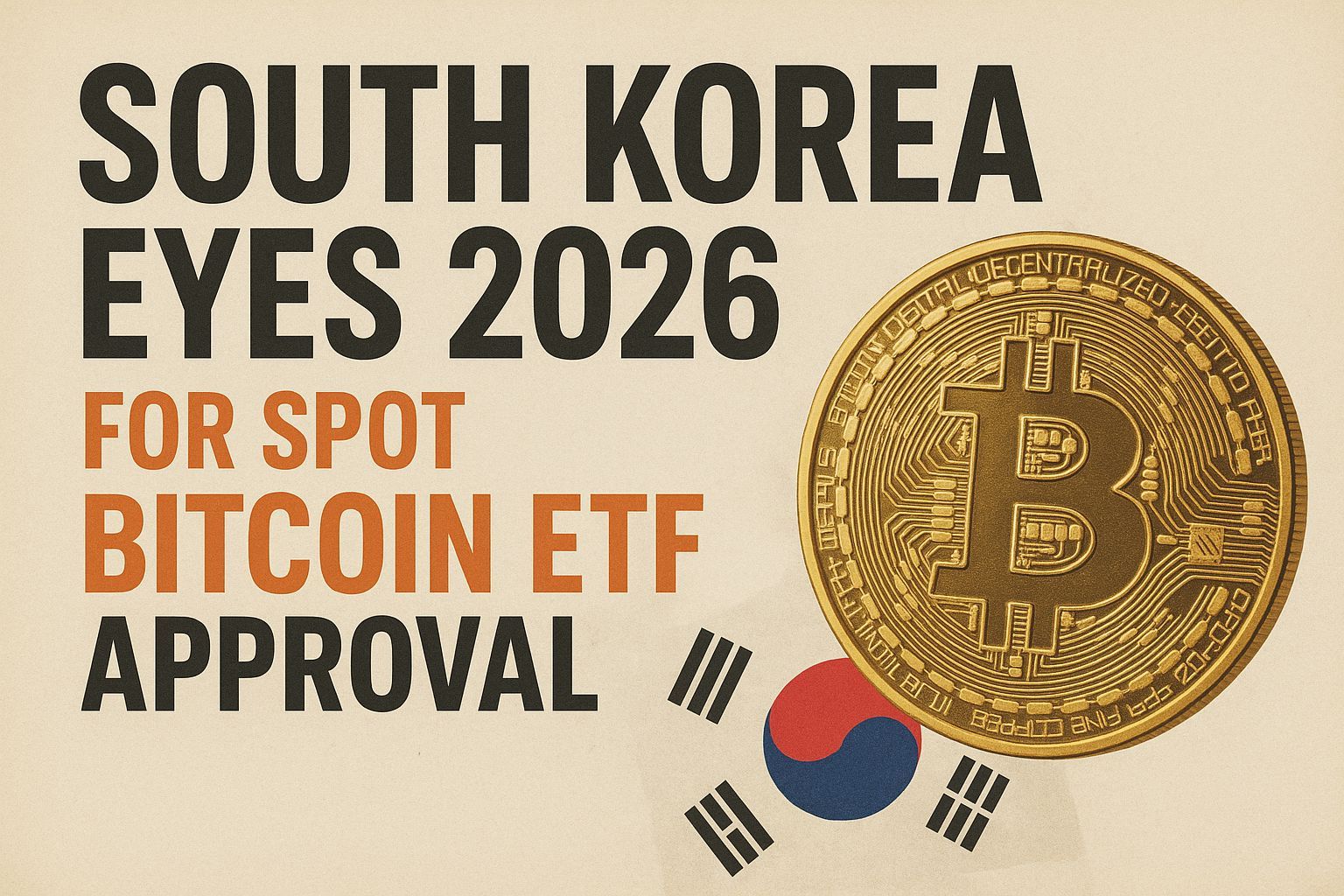
The Quiet Pivot: Why Korea’s 2026 Bitcoin ETF Plan Isn’t Just Another Headline
South Korea eyeing 2026 for spot Bitcoin ETF approval and growth isn’t some random policy memo - it’s a full-on strategic pivot baked into the country’s official 2026 Economic Growth Strategy, with regulators explicitly prioritizing spot Bitcoin ETFs and broader spot digital-asset ETFs for domestic investors.[1][2][3][4][5][6] This is Korea finally deciding it doesn’t want to sit on the sidelines while the US and Hong Kong scoop up all the crypto ETF flows.
Key Takeaways: The TL;DR Before We Go Deep
- Spot Bitcoin ETFs are now explicitly on Korea’s 2026 roadmap, after years of being blocked by rules that didn’t even recognize BTC as a valid ETF underlying asset.[2][3][4][5][6]
- The ETF push is part of a bigger “Phase 2” digital asset law package, centered on tight, post‑Terra stablecoin rules and formal licensing.[2][3][5]
- Policymakers are studying US and Hong Kong Bitcoin ETF markets as templates, hinting they want real institutional scale, not just a retail toy.[3][4][5]
- By 2030, Korea wants up to 25% of certain treasury operations on blockchain, plus deposit tokens and tokenized payment rails - this isn’t a side experiment.[1][3][5]
- Market analysts cited in coverage call the move a “watershed moment” and “major policy shift” away from pure crackdowns toward institutional adoption.[1][3][5]
Subscribe to our Social Media for Exclusive Crypto News and Insights 24/7!
From Terra Trauma to ETF Ambition: What Changed in Seoul?
For years, Korean regulators basically treated crypto like that cousin no one invites to family gatherings - tolerated, but not officially embraced. Spot Bitcoin ETFs? Completely off the table. Existing capital market rules didn’t even recognize crypto or Bitcoin ETFs as eligible ETF underlyings, which made launching them legally impossible.[2][3][4][5][6]
Then Terra happened.
- The Terra-Luna collapse in 2022, with roughly $40 billion wiped out and deep Korean ties, was a national embarrassment and a regulatory wake‑up call.[2]
- Regulators shifted into “never again” mode, focusing heavily on stablecoins, reserves, and issuer accountability.[2][3][5]
According to government plans, the new Phase Two Digital Asset legislation will:
- Introduce a licensing/approval system for stablecoin issuers.[2][3][5]
- Require minimum capital levels plus 100% (or more) reserve backing of issued tokens.[2][3][5]
- Guarantee redemption rights for holders, with legal clarity.[2][3][5]
- Add standards for cross-border stablecoin transfers, coordinated with the Ministry of Economy and Finance.[2][3][5]
One commentator quoted in coverage said this is the first time the Korean government is formally recognizing virtual assets as legitimate financial instruments rather than just speculative chips.[5] That change in mindset is exactly what opens the door for spot Bitcoin ETFs.
So What’s Actually in the 2026 Plan for Bitcoin ETFs?

The 2026 Economic Growth Strategy doesn’t just casually mention ETFs - it explicitly backs launching spot digital-asset ETFs, with priority for a Bitcoin ETF as early as 2026, and directs regulators to start the formal groundwork now.[1][2][3][4][5][6]
Key elements from multiple reports:
- Spot Bitcoin ETF priority: Bitcoin is named as the first in line within the digital-asset ETF push.[1][2][3][4][5][6]
- Domestic access focus: These ETFs are meant for Korean domestic investors who’ve historically been pushed offshore for serious BTC exposure.[1][2][3][5]
- Regulatory alignment: The Financial Services Commission (FSC) is leading, tying ETF approval into the larger Phase 2 crypto law package.[2][3][5]
- Timeline:
- Work starts now on the regulatory and legislative framework.
- Stablecoin rules are targeted to be finalized by Q1 2026.[5]
- Spot digital asset ETFs - with Bitcoin first - are part of the 2026 rollout vision, with some sources noting plans to “introduce spot digital asset ETFs this year” as the strategy kicks in, and others emphasizing 2026 as the core policy target year.[1][3][4][5][6]
A breakdown from Bitcoin Magazine notes that once approved, spot Bitcoin ETFs would be available to domestic investors for the first time, putting Korea in the same conversation as the US and Hong Kong, where similar ETFs have already attracted billions in inflows.[2]
Looking at the Playbook: US & Hong Kong as “Reference Markets”
Korean regulators aren’t reinventing the wheel. They’re explicitly using the US and Hong Kong spot ETF markets as references.[3][4][5]
- US:
- SEC approved spot Bitcoin ETFs in January 2024 and spot Ethereum ETFs in July 2024.[4]
- Those products saw strong inflows, with multiple issuers competing on fees and liquidity.[4]
- Hong Kong:
- Allowed spot Bitcoin and Ethereum ETFs in April 2024.[4]
- Later opened the door to altcoin-linked ETFs such as Solana in 2025, demonstrating regulator comfort with broader crypto exposure once guardrails are in place.[4]
One industry summary notes that South Korea specifically cited these active spot ETF markets as key reference points, both for product structure and for regulatory risk management.[3][4] That signals a couple of things:
- They’re aiming for institution‑grade infrastructure - think professional custodians, tight spreads, daily transparency.
- They want to keep Korean capital onshore, not dripping out to US and HK exchanges and ETFs.
Honestly, that move caught a lot of people off guard. Korea has long been one of the most vigorous enforcement-heavy jurisdictions post‑Terra. To go from that to “Let’s build a compliant ETF ecosystem” is a real pivot.
Why a Spot Bitcoin ETF Matters So Much for Korea’s Market Structure

You’ve seen this movie in the US: ETFs land. Flows spike. Volatility compresses for a bit. Then the dominance cycles kick in.
Here’s what coverage and official commentary imply for Korea:
Capital re-onshoring:
For years, serious Korean BTC exposure often meant using offshore exchanges and platforms, since local spot ETFs were banned and regulatory clarity was thin.[2][3][5]
With a domestic spot ETF, that flow can shift to regulated local brokers and asset managers.Institutional doors open:
Market observers in one report note that ETF approval is likely to accelerate institutional participation, including pension funds and corporate treasuries.[5]
Those players aren’t wiring to offshore exchanges - they’re waiting for something like a regulated ETF wrapper.Market perception shift:
One analyst quoted in coverage said this marks a pivot from viewing crypto as “pure speculation” toward treating it as a legitimate part of the financial and fiscal system.[5]
That’s important. Perception often leads liquidity.
And when liquidity deepens in a new region, you tend to get:
- Tighter spreads on BTC/KRW pairs.
- More arbitrage between Korean and global markets (the classic “Kimchi premium” gets disciplined).
- Gradual growth in derivative depth around the ETF ecosystem - options, structured products, basis trades.
The whales ain’t sleeping, fam. They’re rotating.
Regulatory Guardrails: Stablecoins, Licensing, and “Phase Two”
The ETF push doesn’t happen in a vacuum. It’s bolted onto a pretty aggressive regulatory overhaul.
According to multiple sources:
Stablecoin issuers will need:
- Government authorization and licensing.[2][3][5]
- Capital requirements to absorb shocks.[2][3][5]
- 100%+ reserve backing of circulating tokens.[2][3][5]
- Clearly defined redemption rights for holders.[2][3][5]
Cross‑border oversight:
Standards are being drafted for international stablecoin transfers, in coordination between the FSC and Ministry of Economy and Finance.[2][3][5]Exchange & transfer risk:
Oversight will extend to overseas transfers and settlement flows, balancing innovation with financial stability.[3][5]
This is clearly Terra‑scar tissue talking. Regulators want ETF‑style BTC exposure inside a framework where:
- On‑ and off‑ramps are supervised.
- Fiat and stablecoin rails are auditable.
- Custody and reserves can be examined - and seized if needed.
On that last point, one legal development dovetails neatly with the ETF plan: the South Korean Supreme Court ruled that exchange‑held Bitcoin can be seized under certain conditions, reinforcing the idea that crypto sits firmly within the legal and enforcement perimeter.[6]
Beyond Bitcoin: Deposit Tokens, Blockchain Treasuries, and Public Finance
The 2026 strategy isn’t just about making traders happy. It’s about re‑wiring parts of the state’s financial plumbing using blockchain.
According to policy summaries:[1][3][5]
- Korea plans to explore deposit tokens - blockchain versions of bank deposits, not standalone volatile coins.
- By 2030, up to 25% of certain treasury operations could be conducted on blockchain rails.[1][3]
- The government is piloting blockchain-based payment and settlement systems and plans to revise the Bank of Korea Act and National Treasury/Bank Management Acts to legally support them.[2][3][5]
- E‑wallets will be provided to facilitate token-based payments for specific government expenses.[3][5]
So, the ETF isn’t a random one‑off. It’s step one in a bigger picture:
- Regulated spot ETFs (starting with Bitcoin).
- Stablecoins with bank‑style rules.
- Deposit tokens tied to treasury flows.
- Blockchain-based settlement rails for parts of the public sector.
If that rolls out as envisioned, it could make Korea one of the most structurally integrated crypto‑and‑state financial ecosystems among major economies.
How This Could Feed Into Bitcoin’s Next Dominance Cycle
Let’s zoom out and think like a macro crypto investor for a second.
We’ve watched a pattern repeat:
- New jurisdiction approves spot BTC ETFs.
- Flows start slow, then trend up as trust and familiarity build.
- Bitcoin dominance (BTC.D) often rises during early ETF phases as “safer” large-cap exposure gets priority.
- Once that phase matures, capital starts to rotate into ETH and major altcoins, often after volatility compresses.
US and Hong Kong data, cited by Korean policy references, show exactly this dynamic:
- First, Bitcoin spot ETFs get greenlit and absorb the bulk of inflows.[2][4]
- Later, Ethereum and selected altcoin products gain traction, once regulators are comfortable and market infrastructure is stable.[4]
Korea is setting itself up to join that same cycle:
- Phase 1 (2026+): Spot Bitcoin ETF as the institutional entry ramp.
- Phase 2: Spot digital-asset ETFs more broadly - potentially ETH and selected majors, mapped onto stricter rules.
- Phase 3: Interplay between ETFs, regulated stablecoins, deposit tokens, and tokenized payment rails across state and corporate finance.
If you’ve traded previous cycles, you know how this goes:
- At first, BTC soaks up the narrative: “safe, regulated, first‑mover ETF asset.”
- As structural buying builds, volatility on dips gets shallower - institutions tend to scale in rather than panic dump.
- At some point, altcoin rotation begins: “We’ve got BTC, what’s next on the approved menu?”
You’ve seen this before, right? BTC teasing breakout, then faking out - until flows from a new region finally push it through resistance for real.
Risk, Over‑Regulation, and the Shadow of Terra
Of course, it’s not all sunshine and green candles.
Several consistent risks pop out from the policy and coverage:
Over‑regulation squeeze:
High capital requirements, strict reserves, and intense cross-border oversight could raise the barrier to entry for smaller issuers and platforms.[2][3][5]
That might slow innovation, especially in DeFi‑style products that don’t map neatly onto bank‑style rules.Timeline & political risk:
Everything hangs on the successful passage and implementation of Phase Two legislation and related amendments to central bank and treasury laws.[2][3][5]
Political turnover, scandals, or another major crypto blow‑up could delay or water down the ETF rollout.Concentration of power:
With high compliance costs, the ecosystem could skew toward big incumbents - large banks, major brokerages, or a handful of megaplatforms - which might mean fewer choices and lower yields for retail users.
Still, one market analyst cited in coverage called the comprehensive strategy “a turning point for Korean crypto policy”, specifically because it moves from punishment and patchwork to a coherent, long-term roadmap.[5]
Back in 2022, a lot of Korean holders watched Terra implode, exchanges tighten rules, and regulators slam the brakes. It was brutal. But it taught one thing that’s now written into policy: if crypto is going to exist at scale, it has to live inside serious regulatory architecture - not just hype and vibes.
So, As an Investor, How Do You Frame This?
You don’t need to trade Korea directly to care about this. Here’s how a savvy investor might think about it:
Structural BTC demand story:
Another major economy lining up a spot Bitcoin ETF regime is one more long‑run demand vector for BTC - not necessarily explosive on day one, but cumulatively powerful.[1][2][3][4][5][6]Regional narrative rotation:
For years, Korea was known for altcoin speculation and the “Kimchi premium.” This time, the story might be “Korea the regulated gateway”, starting with BTC.Policy premium vs. risk discount:
If they execute this well - stablecoins with bank‑like discipline, ETFs with robust custody, and clear on‑chain treasury experiments - you could see a policy premium attached to Korean-linked flows. Mess it up, and the market slaps a risk discount instead.Watch the sequencing:
The key milestones to track based on the plan:- Stablecoin rules finalized around Q1 2026.[5]
- Bank of Korea / treasury‑related amendments passed and piloted.[2][3][5]
- Actual listing and launch of the first domestic spot Bitcoin ETF on Korean exchanges.
By the time that first spot Bitcoin ETF prints its opening tick in Seoul, a large chunk of the story will already be priced in. But the second‑order effects - institutional mandates, new structured products, pension allocations - can take years to mature.
ETH just said “nope” to resistance. Again. But BTC? BTC keeps quietly burrowing deeper into the old‑world financial stack. Korea’s 2026 ETF plan is one more brick in that wall.
Spot Bitcoin ETF South Korea
2026 Economic Growth Strategy
South Korea crypto regulation
- https://whale-alert.io/stories/e777a737f45f/South-Korea-preparing-to-approve-spot-bitcoin-ETFs-for-domestic-investors-amid-fast-tracked-stablecoin-rules
- https://bitcoinmagazine.com/news/south-korea-to-approve-spot-bitcoin-etfs
- https://www.mexc.com/en-NG/news/443345
- https://bitcoinist.com/south-korea-bitcoin-spot-etf-targets-2026-rollout/
- https://www.kucoin.com/news/flash/south-korea-to-finalize-stablecoin-laws-in-q1-2026-and-approve-spot-crypto-etfs
- https://bravenewcoin.com/insights/south-koreas-top-court-rules-exchange-held-bitcoin-can-be-seized






