
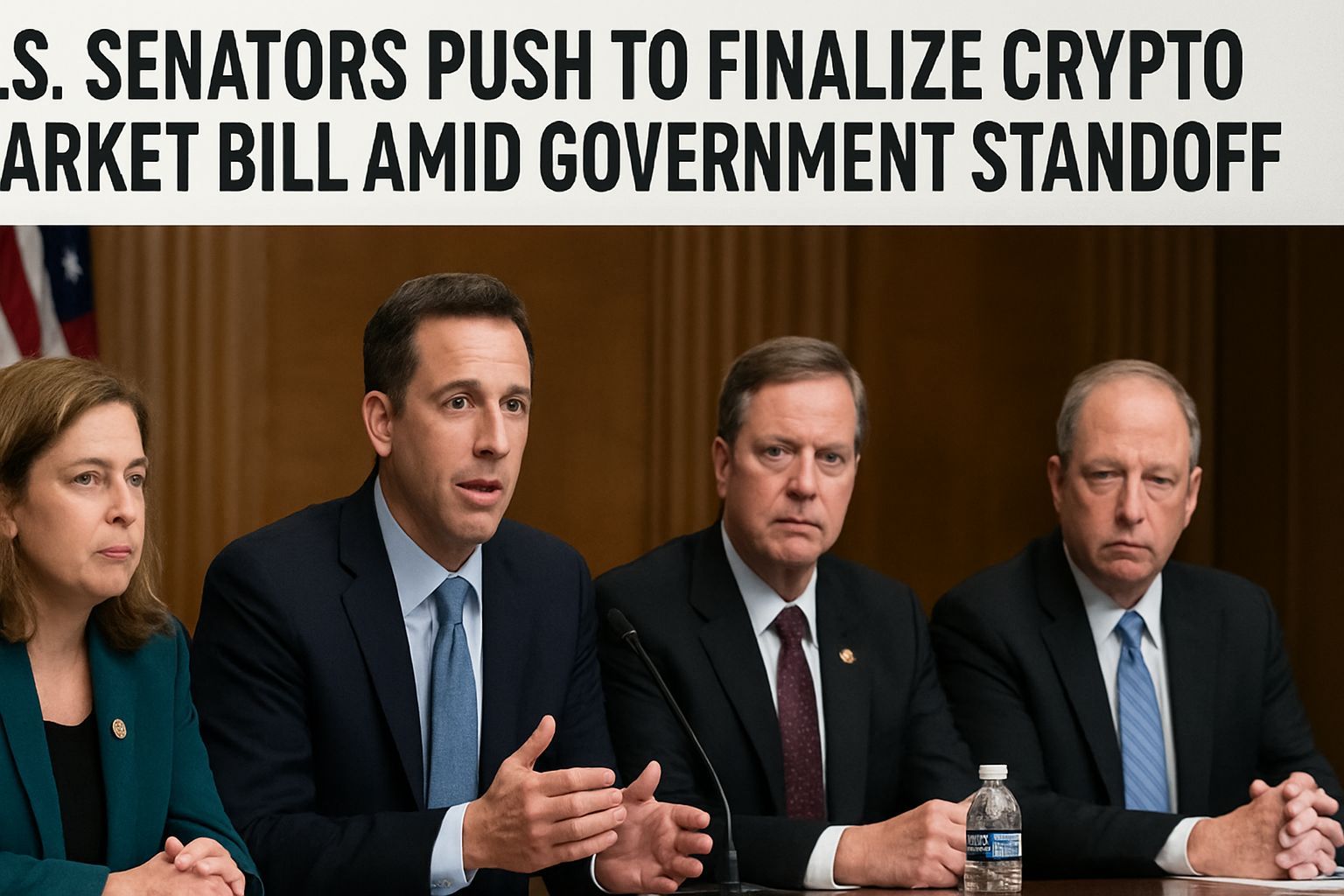
Government Gridlock Meets Crypto Ambition: Will Senators Break the Deadlock?
The U.S. Senate is pushing hard to finalize a crucial crypto market bill amid an increasingly tense government standoff-the kind of legislative drama that every crypto fan loves to dissect. With the crypto market itching for clarity, and federal agencies in a tug-of-war over jurisdiction, senators are racing against the clock to pass the Digital Asset Market Clarity Act (CLARITY Act) before the year ends[1][2][5]. This push is happening even as the government shutdown looms as one of the longest in U.S. history, muddying the legislative waters and adding a hefty dose of uncertainty for investors and industry players alike[4].
If you’re wondering why this matters to your portfolio, your favorite tokens, or the trajectory of crypto innovation stateside, stick around. We’ll unpack the bill’s nuances, dissect market data, and share some legit pro insights to make sense of the chaos. Oh, and don’t worry-I’ll keep it conversational, because no one wants a snooze-fest when crypto and Capitol Hill collide.
Key Takeaways
Subscribe to our Social Media for Exclusive Crypto News and Insights 24/7!
- Bipartisan momentum behind the CLARITY Act aims to untangle SEC and CFTC jurisdiction over digital assets.
- U.S. Senate targets a wrap-up of crypto market legislation by September 30, 2025, despite the ongoing government standoff.
- Market mechanics like Bitcoin dominance cycles and ETH’s resistance battles give context to how regulation news shakes the charts.
- On-chain insights show whales rotating assets while traders brace for volatility around legislative milestones.
- Expect ripple effects on liquidity, derivatives, and stablecoin regulation following final passage of related acts like the GENIUS Act.
?️ So, What’s the Big Deal About the CLARITY Act?

Picture this: You’re trying to play a game, but the referees keep bickering over who calls the fouls. That’s kinda where crypto regulation’s been for years in the U.S. The Securities and Exchange Commission (SEC) and Commodity Futures Trading Commission (CFTC) have both been staking claims on crypto territories-sometimes stepping on each other’s toes. The result? Market participants are left guessing, innovation gets shackled, and capital often runs abroad.
Enter the CLARITY Act of 2025[2], designed to put a framework around:
- Clear definitions on what counts as a security vs. a commodity in crypto.
- Jurisdictional boundaries so SEC and CFTC can play nice.
- Expedited registration processes for exchanges, brokers, and dealers, cutting red tape.
- Provisions for stablecoins, aligned with the GENIUS Act (which already laid groundwork on payment stablecoins)[1][3].
Senate Banking Chairman Tim Scott said he’s aiming to finish this by September 30, 2025, despite the government shutdown drama stacking up[1][5]. That’s a tight deadline when Congress is juggling shutdowns and partisan theatrics, but the crypto market’s been pressing hard, and senators seem to be listening.
? Market Mayhem Meets Senate Showdown - What’s the Impact?
Crypto markets don’t just react to price charts-they thrive on narrative momentum, especially around regulation. Throw in US senators scrambling to finalize a bill amid a government impasse, and you get an extra layer of volatility.
Looking at CoinMarketCap’s live data, Bitcoin (BTC) dominance has been oscillating near 45%, showing cyclic rotation - classic behavior before a big legislative event[Chart from CoinMarketCap]. Ethereum (ETH), not surprisingly, has been struggling to clear resistance around $2,100. It hasn’t just hesitated - it swan-dived into support zones multiple times, dragging altcoins down with it[TradingView].
Now, here comes the juicy part: On-chain metrics reveal liquidation cascades heating up, especially on derivatives platforms. That means traders are cashing out their leveraged bets fearing whipsaws from the legal uncertainty. A trader I caught up with this week said, “This smells eerily like 2021’s blow-off top, but flipped upside down-everyone’s nervous, but the whales ain’t sleeping, fam. They’re rotating like pros.”
The ADX (Average Directional Index) readings confirm a strong trend in market dominance shifts, swinging from altcoins back to BTC whenever regulatory news gets messy. It’s a rollercoaster, but savvy traders can spot these cycles as chances to rebalance their bags.
? Insider Scoop - How Stablecoins Play Into This Legislation

Stablecoins, the digital dollar of crypto, have been under the microscope since the fallout of 2022’s Terra fiasco. The GENIUS Act passed earlier this year targeted regulation for payment stablecoins with strict oversight mechanisms, aiming to prevent unregulated stablecoin “black holes” in the market[3].
The CLARITY Act steps in to complement this by including broader digital asset definitions and smoothing the coexistence of stablecoin regulations with crypto commodity rules. This means exchanges and issuers can operate with less fear of conflicting federal crackdowns.
Bank of America’s recent research points out stablecoins’ critical role as on-ramps and liquidity pools in crypto trading ecosystems, so clarity here could unlock trillions in institutional flows waiting on the sidelines[1] Bank of America report.
And here’s a kicker: Some provisions aim to harmonize Commodity Pool Operators’ and Investment Advisors’ obligations, which could boost participation by big money managers who’ve stayed cautious due to overlapping rules.
? Deep Dive - Historical Context for These Market Moves
Remember 2021? The year BTC teased a breakout above $70,000 only to fizzle out and dump 50% over the next months? The tell-tale signs were heavy liquidation cascades, sudden ETH resistance failures, and whales zooming out of long-term positions.
The current scenario has shades of that, although on a different trigger: legislative uncertainty rather than technical overextension.
Back in 2022, I held ADA through a brutal 60% dump during regulatory clampdowns. That experience carved some battle scars, teaching me this: When lawmakers signal they’re “finalizing clarity,” it’s rarely a smooth slide. Expect rollercoasters, but with proper stops and entries, it’s also an asymmetric opportunity.
The upcoming vote on the CLARITY Act is gearing to either cement crypto’s legitimacy or throw a wrench in institutional adoption momentum. That’s why long holders and traders alike need to read the charts and the congressional tea leaves.
What Analysts Are Saying (That You Won’t Hear on Twitter)
“While the government shutdown threatens to delay passage, the bipartisan support means we’d’ve expected a last-minute Senate sprint,” says Jamie Liu, crypto strategist at Horizon Insights. She notes the market’s current hangover from regulatory FUD “is the kind that can flip bullish as soon as the Senate’s hammer drops.”
Another insider, Mark Henderson, a former derivatives trader, argues the bill’s clear jurisdictional boundaries will “reduce cross-agency confusion and likely tame the wild swings we see from enforcement raids.” According to Henderson, regulation clarity “is the grease the institutional gears desperately need.”
And here’s a neat tidbit: Some whales are already positioning ahead of the bill, rotating from altcoins into BTC and carefully calibrated stablecoins. The idea? Manage liquidation risk while banking on regulatory certainty pumping fresh inflows.
? What Should You Do as an Investor?
Here’s the no-BS lowdown:
- Stay nimble: Expect price swings and liquidation cascades near key legislative dates.
- Watch dominance cycles: BTC dominance could surge as safer bets amid uncertainty, then altcoins could jump once clarity arrives.
- Keep an eye on ETH resistance: ETH’s battle around $2,100-$2,200 is telling - breakouts here could trigger wholesale altcoin rallies.
- Consider stablecoins for liquidity: Post-GENIUS and CLARITY regulatory shifts, stablecoins may become the go-to for safer yield and trades.
- Read the Senate drama like a chart pattern: The shutdown could stall, spur delays, or cause accelerated action. Price actions will follow.
Honestly, that push to finalize the crypto market bill amidst a government standoff could be the catalyst that makes 2025 a defining year in U.S. crypto regulation-and market dynamics.
Crypto Market Bill: US Senators Push and Government Standoff FAQ - All Your Burning Questions Answered
Q1: What exactly is the CLARITY Act and why is it important?
A1: The CLARITY Act is proposed legislation aiming to clearly define who regulates digital assets-the SEC or CFTC-and reduce regulatory confusion. It’s vital because it promises to provide a uniform framework that will help exchanges, issuers, and investors operate confidently in the U.S. crypto market.
Q2: How does the ongoing government shutdown affect crypto legislation?
A2: The prolonged shutdown slows down congressional work, threatening timely passage of crypto bills like the CLARITY Act. However, bipartisan pressure means Senate leaders are pushing to finalize before year-end despite shutdown hurdles.
Q3: What impact could this legislation have on stablecoins?
A3: Complementing the GENIUS Act, the CLARITY Act seeks to regulate stablecoins more effectively, giving issuers clearer federal guidelines and reducing risks of regulatory crackdowns, which could enhance stablecoins’ stability and adoption.
Q4: How have crypto markets historically reacted to regulatory uncertainty?
A4: Usually, markets face increased volatility and liquidation events when regulatory news causes uncertainty. Past examples include Bitcoin dumps in 2021 and the 2022 ADA crash, where traders panicked but later found opportunities to buy at lower prices.
Q5: What technical indicators should traders watch during this legislative period?
A5: Traders should watch Bitcoin dominance cycles for shifts in market leadership, Ethereum’s resistance levels (notably around $2,100-$2,200), and the ADX reading to gauge trend strength. Liquidation data on derivatives platforms can also signal impending volatility.
Q6: Will clearer legislation attract more institutional investment into crypto?
A6: Absolutely. Clear jurisdiction and streamlined rules lessen legal risks, encouraging institutional investors who’ve been on the sidelines due to regulatory uncertainty, potentially unlocking massive new capital flows.
crypto market bill
CLARITY Act 2025
stablecoin regulation US
- https://www.arnoldporter.com/en/perspectives/advisories/2025/08/clarifying-the-clarity-act
- https://www.congress.gov/bill/119th-congress/house-bill/3633/text
- https://www.congress.gov/bill/119th-congress/senate-bill/1582/text
- https://www.coindesk.com/policy/2025/11/01/state-of-crypto-the-government-shutdown-nears-a-record
- https://incrypted.com/en/u-s-senate-continues-work-on-crypto-market-bill-despite-shutdown/






