
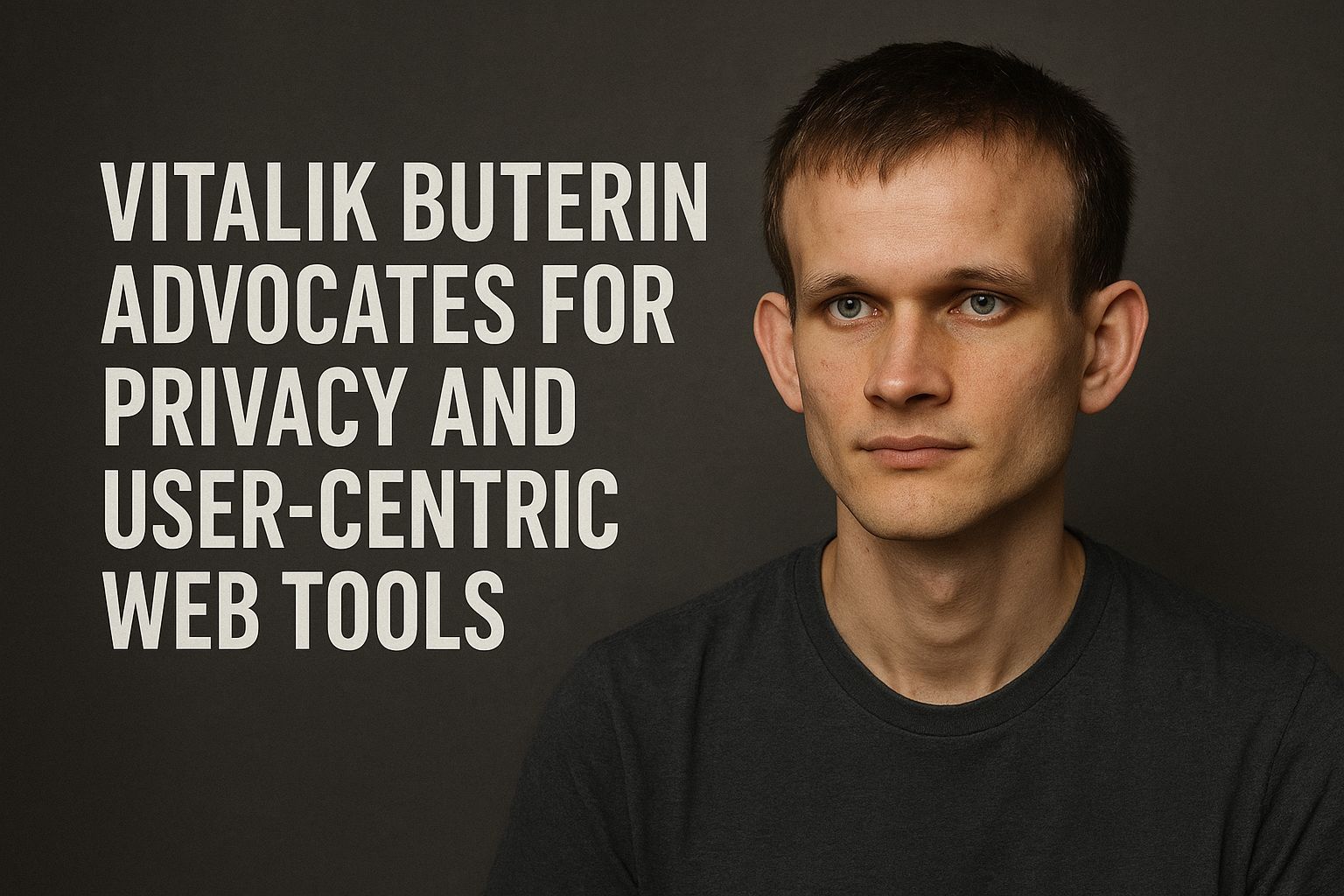
The Quiet War for Your Data Is Here (And Vitalik’s Picking a Side)
Vitalik Buterin’s push for privacy and user‑centric web tools isn’t just some idealistic rant - it’s turning into a full-blown framework for how Ethereum, Web3, and even crypto finance should evolve next.[2][3][4][5] He’s talking Sovereign Web, local-first apps, privacy-preserving tools, and financial systems that grow your wealth without turning you into exit liquidity for overleveraged degen casinos.[3][4][6]
He’s basically saying: if crypto just recreates Web2 “corposlop” - sleek apps, hidden data extraction, dopamine farming, and reckless leverage - then what was the point?[3][4][5]
Key Takeaways - Why This “Sovereign Web” Stuff Matters for Your Bags
Subscribe to our Social Media for Exclusive Crypto News and Insights 24/7!
- Vitalik’s core thesis: Build a Sovereign Web - privacy-first, local-first, user-controlled apps, identities, and financial tools.[2][3][4][5][6]
- Privacy is back as a core feature, not a side quest: ZK proofs, decentralized identity, encrypted docs, hardened OSs, and open-source tools are front and center.[1][2][4]
- He’s openly attacking “corposlop”: profit-maximizing, brand‑polished, algorithmic, user‑manipulating platforms that own your data and your attention.[3][4][5]
- On the finance side: Vitalik wants tools that grow wealth responsibly, not leverage-driven roulette wheels and loans for “small purchases.”[4][6]
- Institutional ETH flows aren’t slowing: over 1 million ETH staked recently despite lower yields - while Vitalik simultaneously warns about an “identity crisis” for Ethereum’s values.[5]
- Market infrastructure is moving his way: ZK, decentralized identity (DID), and governance tools are seeing serious growth expectations, with blockchain identity projected toward $207B by 2034.[2]
Vitalik’s “Sovereign Web”: Ethereum as a Defense Against Corposlop

Let’s start with the new headline that actually matches the data:
Vitalik Buterin’s Sovereign Web Vision: Privacy-First Tools vs. Corporate “Corposlop” Internet
Vitalik’s recent posts and comments outline a Sovereign Web built on three pillars:[2][4]
- Privacy‑preserving apps (think ZK, encrypted docs, local-first tools)
- Decentralized identity systems (DID, selective disclosure, self-sovereign identity)
- Autonomous governance models (DAOs and opinionated communities, not engagement-maximizing platforms)
According to coverage of his Sovereign Web framework, the point isn’t to make Ethereum the fastest or smoothest UX machine - it’s to make it a resilient base layer for digital sovereignty.[2] That means:
- You own your identity and data
- You choose what gets shared, with whom, and when
- You’re not stuck inside “walled gardens” optimized to farm your attention and sell your behavior to advertisers[3][4][5]
He argues the corporate internet is built around profit-driven metrics, while the Sovereign Web should optimize for user sovereignty and long-term human well-being.[2][4][5]
A line from one Sovereign Web explainer sums it up: Ethereum isn’t just a financial machine - it’s a counterweight to surveillance and manipulation, using privacy tools and decentralized governance to keep power from centralizing again.[2][4]
What Vitalik Means by “Corposlop” (And Why He’s So Mad About It)

Vitalik coined and unpacked the term “corposlop” on Farcaster, and it’s brutal.[3][4][5]
Corposlop =
- Corporate optimization + sleek branding
- Short-term dopamine hits over long-term value
- Profit-maximizing behavior that sacrifices user autonomy and ethics[3][4][5]
He calls out:
- Social media designed for “short-term dopamine hits,” not meaningful content[3][4][5]
- Data-harvesting “walled gardens” that trap users and lock in network effects[3][4]
- Soulless, homogenized content designed to be safe, bland, and hyper-optimized for metrics[3][4]
One article notes him arguing that digital sovereignty today isn’t just about self-custody - it’s about “securing your own mind from corporate mind warfare trying to extract your attention and your dollars.”[5] That’s not subtle.
He contrasts this with the Sovereign Web, which:
- Uses privacy-preserving, local-first apps
- Gives users control over social feeds and algorithms
- Builds financial tools that grow wealth responsibly
- Designs AI to augment thinking, not do it for you[4][5][6]
A commentator quoted on the Sovereign Web piece puts it even more bluntly: “Make tools for the empowerment of the user. Oppose corposlop. Believe in something higher than profit.”[4]
Privacy and Tools: Vitalik’s Actual Favorites for Staying Sovereign

Vitalik isn’t just tweeting ideals - he’s naming and using tools.[1][2][4]
1. Privacy & Device Sovereignty: Hardened, Open, Local-First

A DL News piece breaks down a list of privacy tools Vitalik highlighted at the Ethereum Cypherpunk Congress in Buenos Aires.[1] The thread focuses on:
- Hardened, privacy-first operating systems with an open-source kernel that can be publicly audited[1]
- Sandboxed Android app environments, where apps like Maps or Gmail run in isolation so they can’t just slurp your data[1]
- Full encryption and granular controls over what apps can access which sensors and networks, and for how long[1]
These systems let you:
- Decide which data leaves your device
- Limit app permissions to the bare minimum
- Stay open-source so anyone can audit the stack for backdoors or shady behavior[1]
It’s very on-brand Vitalik: don’t just trust platforms - verify the whole stack.
2. dDocs & Self-Sovereign Collaboration
Instead of using Google Docs for everything, Vitalik boosted Fileverse’s dDocs tool in 2024.[1]
Key traits he highlighted:[1]
- Self-sovereignty: Your work life shouldn’t depend on a centralized corporation’s survival
- End-to-end encryption: So even the provider can’t read your documents
- Standards compliance: You can import/export, not get trapped in a proprietary format
He shared that dDocs is “working towards fully peer-to-peer / client-side including the collaboration features,” which is basically Google Docs without Google - you keep the convenience but cut out the corporate middleman.[1]
Identity: From Login Buttons to $207B Self-Sovereign Markets
Vitalik’s Sovereign Web thesis leans heavily into decentralized identity (DID) as infrastructure, not just a feature.[2][4]
An in-depth breakdown of his framework explains that DIDs allow users to:
- Control their digital identity without centralized issuers or identity silos
- Selectively disclose attributes (e.g., proving age, residency, or credentials) without exposing full personal data
- Build pluralistic identity networks, where no single provider owns your “digital self”[2]
The same analysis notes:
- The blockchain identity management market was estimated around $1.57B in 2025
- It’s projected to grow to roughly $207B by 2034, with a ~75% CAGR[2]
That’s not hobby-project territory. That’s “institutions are taking DID and ZK seriously” territory.
The article also points out that institutional investors are backing ZKP-enabled platforms and cross-chain identity solutions, tying this more to infra bets than just retail narratives.[2]
Financial Tools: “Grow Wealth, Not Blow Accounts”
Vitalik didn’t stop at social and identity. He’s coming directly for crypto’s financial UX as well.
In a TradingView/crypto news brief, he calls on developers to:
Refocus on building financial tools that enhance individual sovereignty and grow wealth, instead of reckless leverage bets and hyper-financialized speculation.[6]
Other Sovereign Web coverage echoes this:[4][6]
- Financial tools should grow wealth responsibly, not encourage:
- Extreme leverage
- Risky loans for trivial consumption
- Gamified speculation for engagement metrics
The idea is simple but radical in crypto:
Make finance tools that help people build durable, long-term sovereignty, not just chase 100x memes.[4][6]
That means:
- On-chain tools that align with user resilience, not just volume and fees
- Risk frameworks that prioritize capital preservation and optionality
- Systems that don’t rely on users being uninformed or easily manipulated to be profitable
Ethereum’s Identity Crisis: Sovereignty Vision vs Staking Reality
Here’s where it gets spicy for ETH holders.
One detailed piece points out that while Vitalik is talking privacy, local tools, and sovereignty, the market is simultaneously pushing Ethereum deeper into institutional staking mode.[5]
A few key data points:[5]
- A wallet linked to Vitalik recently sent 330 ETH (~$1.02M) to Paxos
- At the same time, institutions have staked over 1 million ETH in a short window, even with yields near multi‑year lows
- One entity, BitMine, alone staked over 1 million ETH in a month, pushing the entry queue to levels last seen in 2023[5]
So you’ve got:
- Narrative: “We need a sovereign, privacy-first Web that protects users from corposlop.”[4][5]
- Flow-of-funds reality: ETH increasingly locked in large, institutional staking positions chasing yield and infrastructure dominance.[5]
The article frames it as an “identity crisis”:
Is Ethereum becoming the backbone of a sovereign, user-first web, or the yield-bearing base layer for institutional capital, with user sovereignty as a side quest?[5]
There’s no direct answer from Vitalik in the sources, but the tension is obvious.
Market Mechanics: Sovereign Web Infra vs. Corposlop Incentives
While the sources don’t dive into ADX curves or liquidation cascades for this specific theme, they do paint macro mechanics you should keep in mind as an investor.
1. Identity & ZK Infra: Quiet, Narrative-Heavy Upside
From the Sovereign Web breakdown:[2]
- The $207B projected blockchain identity market plus institutional bets on ZKPs and cross-chain solutions suggests a long-duration, infra-heavy wave building under the surface
- This isn’t memecoin mania - it’s more like the L2 boom in its early research phase: dry, technical, but foundational
If Vitalik’s framework continues to gain mindshare:
- Projects aligned with DID, ZK identity, and privacy-preserving infra stand to benefit from narrative tailwinds
- The market may eventually re-rate these from “niche infra” to core Web3 primitives, similar to how rollups went from academic to blue-chip stack components
2. Ethereum Staking Flows: Sovereignty vs Yield
The staking surge highlighted around Ethereum shows how capital flows can diverge from ideals:[5]
- Institutions are locking in ETH positions even as yields drop, signaling:
- Long-term confidence in ETH as a base-layer asset
- Less sensitivity to short-term APY and more to structural exposure
But from a sovereignty lens:
- More ETH controlled by large entities and custodians may clash with the “local-first, user-first” ethos
- Governance and network dynamics increasingly rely on the behavior of large, yield-driven actors
This is where Vitalik’s frame matters: a Sovereign Web needs tools and culture that push back against pure profit optimization - even when that optimization is happening on Ethereum itself.[4][5]
Where This Leaves a Savvy Crypto Investor
If you care about where value accrues over a multi‑year timeline, Vitalik’s Sovereign Web vision is more than ideology - it’s a roadmap for where serious builders and capital may converge.
From the sources, a few grounded, non-hype takeaways:
Privacy isn’t dead; it’s being rebuilt more intelligently.
ZK, DIDs, and privacy-preserving apps are no longer just “dark market tech” - they’re being positioned as the backbone of a $200B+ future market.[1][2][4]User-sovereign tools may become a differentiator in a crowded app landscape.
Open-source kernels, encrypted docs, local-first clients - these are moats against corposlop, not just features.[1][4]Ethereum’s biggest risk may be cultural, not technical.
If the network tilts too far toward institutional yield and corposlop-style app design, it drifts away from the Sovereign Web ideal that Vitalik and early cypherpunks pushed.[4][5]The winners in this theme will likely:
- Align strongly with self-sovereign identity, privacy, and local-first architectures
- Avoid over‑reliance on engagement farming and gambling mechanics
- Integrate with Ethereum as a resilient base layer rather than just a liquidity pipe[2][4][5][6]
You’ve seen this movie before: early infra narratives (L2s, modularity, restaking) look slow and “too nerdy”… until suddenly, they’re the thing everyone claims they always believed in.
The Sovereign Web, as laid out across these sources, has that same feel. Not flashy. Not easy. But if Vitalik’s track record on where this space is heading is any indication, you ignore this pivot to privacy‑first, user‑sovereign tools at your own risk.
- https://www.dlnews.com/articles/defi/vitalik-buterin-top-tool-to-stay-private-and-decentralised-in-2026/
- https://www.ainvest.com/news/vitalik-buterin-sovereign-web-vision-implications-web3-infrastructure-2601/
- https://www.binance.com/en/square/post/01-10-2026-vitalik-buterin-criticizes-corporate-practices-and-advocates-for-sovereign-web-tools-34892809560178
- https://www.mexc.com/news/449859
- https://ambcrypto.com/ethereum-locks-1mln-as-vitalik-buterin-warns-of-corposlop-identity-crisis-ahead/
- https://www.tradingview.com/news/cryptonews:984e6c612094b:0-vitalik-crypto-needs-financial-tools-that-grow-wealth-not-reckless-leverage-bets/






