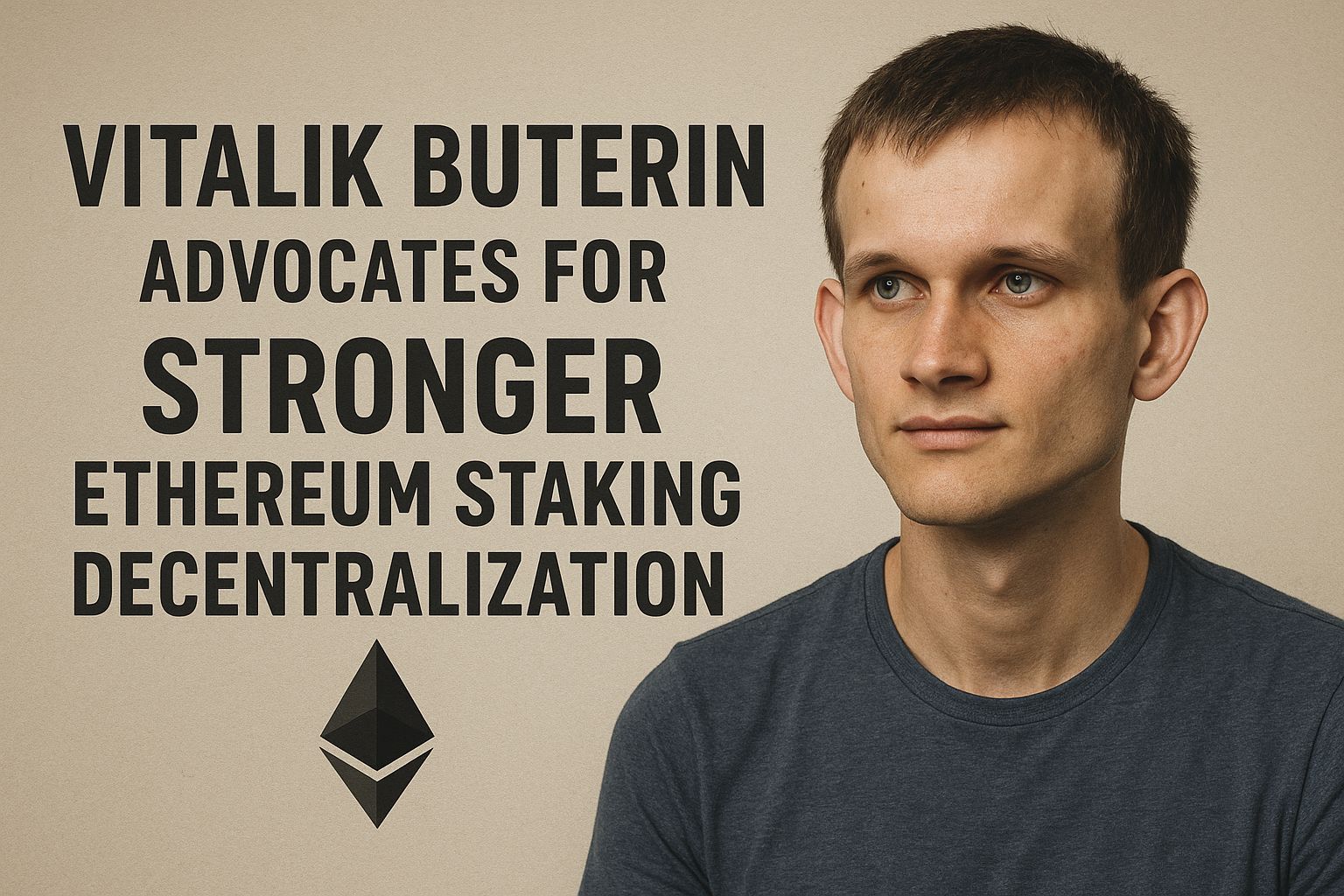
Vitalik’s Vision: How Native DVT Could Finally Decentralize Ethereum Staking
The Blueprint for Breaking Big Staking’s Stranglehold
Ethereum co-founder Vitalik Buterin just dropped a proposal that’s turning heads in the protocol layer-and honestly, it’s addressing something that’s been gnawing at the network for years. He’s pushing for native Distributed Validator Technology (DVT) to be baked directly into Ethereum’s staking protocol, and the implications are massive for anyone who cares about what "decentralization" actually means beyond marketing speak.[3][4][5]
Here’s the thing: Ethereum’s stayed trustless at its core, but somewhere along the way, the user experience got… compromised. Validators started relying on centralized RPC endpoints. Staking became gatekept by mega-providers. The base layer held strong, but everything built on top drifted toward convenience-which meant centralization.[7] Buterin’s calling 2026 the year Ethereum reverses a decade of those tradeoffs, and DVT is a big piece of that puzzle.
Key Takeaways
- Native DVT lets validators register up to 16 independent signing keys under a single validator identity, meaning a cluster of nodes acts as one-reducing single points of failure without sacrificing security[3][4][5]
- The validator keeps operating as long as two-thirds of its nodes stay honest, eliminating the catastrophic risk of one node going down and torching your entire stake[5]
- Current DVT implementations are operational nightmares-complex setups requiring external infrastructure-but protocol-level integration flips the script and makes the trustless path the easy path[5][7]
- This isn’t hypothetical. Kraken already started using DVT for staking via SSV Network in 2025, proving the tech works. Buterin’s saying it’s time to move it onchain[3]
- The real win? Reduced dependency on staking giants. Smaller operators and institutions get breathing room to run their own validators without being strangled by operational complexity[3][5]
Why This Matters More Than It Sounds
The staking game right now resembles a concentration problem dressed up as decentralization. You’ve got massive providers running validators like factories, and individual stakers-if they even bother-are outsourcing everything to centralized infrastructure. It’s not malicious; it’s just friction. The easy thing and the decentralized thing became opposites.
Subscribe to our Social Media for Exclusive Crypto News and Insights 24/7!
Buterin’s proposal flips that. By integrating DVT directly into the protocol, validators could operate across multiple independent nodes-think of it like having a backup band instead of a solo act. If one node stumbles, the show goes on.[5] The slashing mechanism stays intact, meaning bad actors still get penalized. But honest validators? They’re protected from catastrophic downtime.
Here’s what’s wild: the architecture adds "only a slight delay in block generation" while maintaining compatibility with any signature scheme.[5] It’s not some nuclear rewrite that breaks everything. It’s surgical.
The Decentralization Lever Nobody’s Talking About

Beyond the technical elegance, Buterin framed this as essential infrastructure for actual decentralization. The Nakamoto coefficient-that metric measuring how distributed validator power really is-would shift meaningfully if individual operators and institutions felt confident running their own validator clusters without betting the house on a single node.[3][5]
Conservative market participants who’ve been hesitant about staking? This could be their on-ramp. They get security through redundancy. They reduce operational overhead. They don’t need to trust a megaprovider anymore.
Kraken’s 2025 experiment with SSV Network proved the technical foundation works.[3] But here’s the kicker: that’s still infrastructure-level. It’s still got moving parts, complexity, external dependencies. Native protocol integration would be… native. Default. Built-in. The easy button for decentralization.
What’s Actually Being Proposed

Validators holding multiples of the minimum stake can define up to 16 signing keys.[3][4] Operations like block proposals or attestations only validate once they hit a threshold of signatures from participating keys. You set the threshold-maybe two-thirds, maybe higher. Your call.
This distributed approach minimizes validator downtime from single failures or node compromises.[5] The penalty mechanism still functions normally if you screw up-you don’t get free recklessness. But infrastructure failures don’t turn into financial ruin.
The proposal’s still in draft stage on the Ethereum Research forum, meaning community review is incoming.[4] It’s not shipping tomorrow. But the fact that Buterin’s putting this forward now suggests it’s a priority for the roadmap.
The Bigger Picture: Buterin’s 2026 Thesis

This DVT push isn’t happening in isolation. Buterin’s framed 2026 as the year Ethereum stops compromising on trust. On the social side, he’s pivoting away from centralized platforms entirely, moving to decentralized social ecosystems like Lens and Farcaster because he believes society needs better mass communication tools-ones that don’t prioritize outrage and short-term engagement over real value.[1][2]
Same energy. Same principle. Protocol-level fixes that make the trustless path the default instead of the power-user hack.
The Real-World Implication
Right now, if you’re staking 32 ETH or running a validator, you’re either:
- Throwing it at a big provider and trusting them not to mess up
- Running the infrastructure yourself and sweating every maintenance window
DVT on the protocol level collapses that false choice. You run your validator cluster across multiple nodes. You set your security threshold. You get redundancy. You get decentralization. You get peace of mind.
Honestly, it’s the kind of infrastructure fix that’s unglamorous but necessary-like upgrading electrical wiring in a house before you add new rooms. Not exciting to talk about, but everything else depends on it working right.
- https://www.cryptopolitan.com/vitalik-buterin-decentralized-social-2026/
- https://www.kucoin.com/news/flash/vitalik-buterin-to-focus-on-decentralized-social-in-2026
- https://en.bitcoinsistemi.com/ethereum-founder-vitalik-buterin-proposes-a-new-solution-to-enhance-eth-network-security-here-are-th/
- https://phemex.com/news/article/vitalik-buterin-proposes-native-dvt-integration-for-ethereum-staking-54958
- https://forklog.com/en/buterin-proposes-new-validation-model-for-ethereum/
- https://cryptoslate.com/ethereum-may-finally-kill-trust-me-wallets-in-2026-and-vitalik-says-the-fix-is-already-shipping/