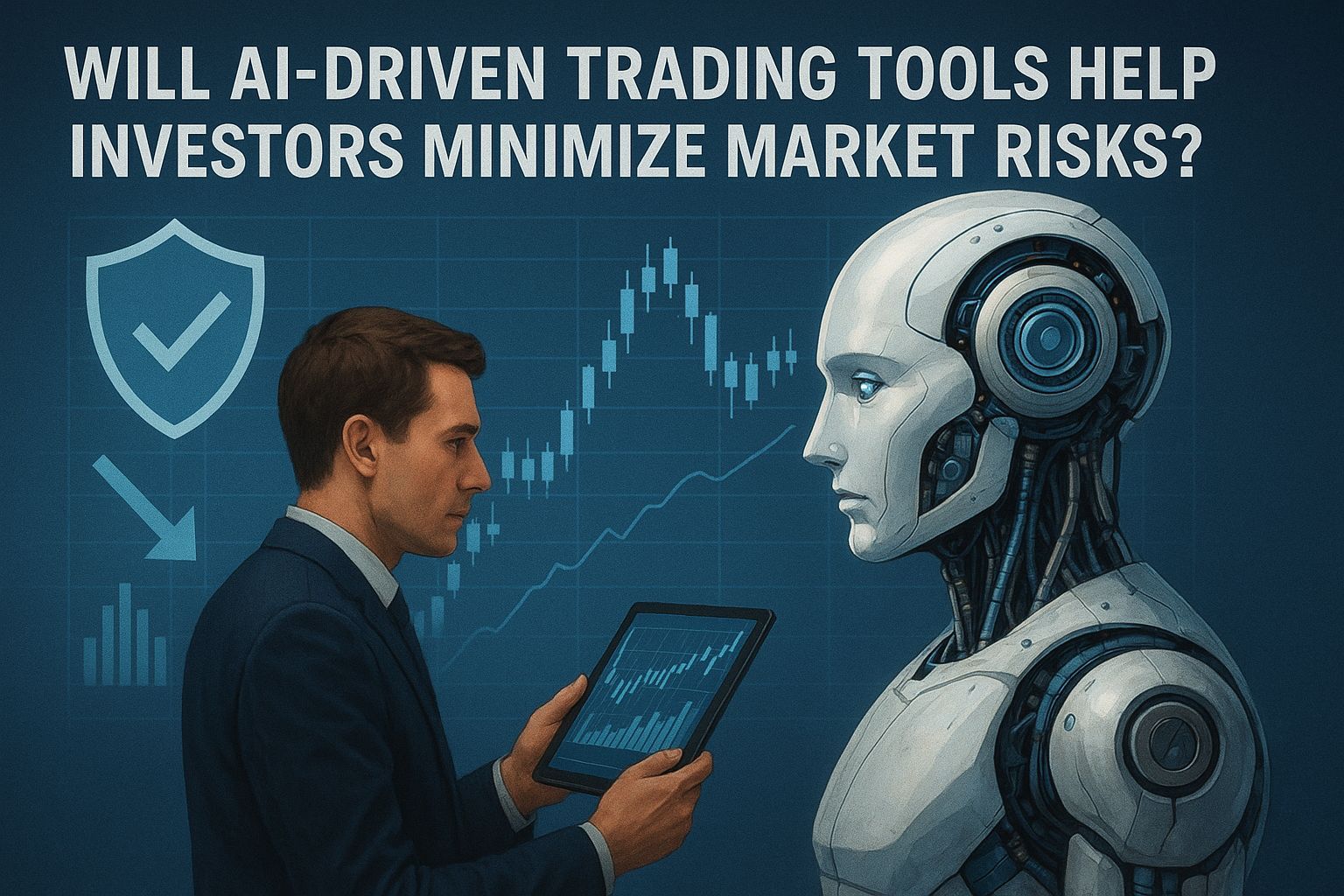
AI-Driven Trading Tools: A Reality Check on Risk Management
The Promise vs. The Pitfall: What AI Actually Does (And Doesn’t) for Your Portfolio
Here’s what everyone wants to hear: AI trading tools will protect your capital and beat the market. Here’s what the data actually shows: they’re powerful risk assistants, not magic bullets. And honestly? That’s still pretty useful.
Key Takeaways
Subscribe to our Social Media for Exclusive Crypto News and Insights 24/7!
- 68% of financial services firms now prioritize AI-driven risk management as a top strategic priority[1], but effectiveness depends entirely on implementation and human oversight.
- AI excels at pattern detection and compliance automation-it can scan years of price data and flag market anomalies faster than any human analyst-but it can’t replace judgment during extreme volatility.
- The real risk? Automation failure and “monoculture” effects where similar algorithms amplify crashes rather than prevent them.
- For individual traders, AI works best as a complementary tool to existing expertise, not as a standalone solution.
What AI Actually Does Well: Speed Meets Precision

Let’s be direct. AI tools can identify patterns across massive datasets that would take you years to manually analyze[5]. We’re talking about scanning price histories, detecting over 220 chart patterns automatically, and flagging technical setups in real-time across stocks, ETFs, forex, and crypto[3].
The efficiency gains are legit. Instead of you staring at candlesticks until your eyes blur, AI processes the grunt work-backtesting strategy variants, managing trade journals, even detecting your own behavioral patterns like overtrading or hesitation[5]. That’s genuinely helpful.
But here’s where it gets interesting: AI improves market efficiency by catching arbitrage opportunities faster than humans, which tightens spreads and boosts liquidity[1]. Sounds great, right? Except when it’s not.
The Dark Side Nobody Talks About: When Algorithms Think Alike
Regulators are genuinely worried about something called “algorithm monoculture.” Picture this: thousands of AI systems, trained on similar data, responding to identical market signals. They all sell at once. The cascade hits before anyone realizes it[1].
Financial authorities have flagged this risk explicitly. When many market participants’ algorithms behave similarly, volatility doesn’t decrease-it amplifies. It’s like everyone in a crowded theater seeing smoke and rushing the same exit[1].
The guardrail? Diverse modeling approaches and human oversight remain critical, even as AI gains prominence[1]. Translation: don’t go all-in on automation. Keep your hands on the wheel.
The Compliance Revolution: Where AI Actually Shines
One area where AI genuinely moves the needle? Compliance and documentation. Natural language processing algorithms can scan ISDA agreements and swap documentation automatically, extracting risk terms for modeling[1]. This gives firms and regulators earlier warnings when trouble’s brewing[1].
As the CFTC has noted, AI in derivatives risk management holds promise for efficiency-but only with proper controls[1]. It’s not flashy, but it matters.
Real Talk: AI Trading Bots Don’t Demonstrably Beat the Market
Before you get swept up, here’s the sobering truth: AI trading doesn’t demonstrably lead to higher profits[2]. The range of success rates varies wildly, and costs range from free to hundreds of euros monthly[2].
The research is clear: AI is most effective when combined with existing trader expertise and common sense[2]. It’s not the trading engine. You are. AI is the turbocharger.
Risk Management That Actually Works
Here’s what separates pros from amateurs: adaptive risk modeling. Some traders in 2026 are running models that dynamically adjust position sizing and stop-losses based on market conditions[5]. You’re not using static rules anymore-the system learns.
Smart platforms integrate automated stop-losses and intelligent position sizing as built-in safety nets[3]. They keep tabs on your exposure while you focus on opportunities. Sounds simple? Most retail traders skip this entirely.
But here’s the catch: when markets crack-genuine extreme events, not just normal volatility-AI effectiveness plummets[3]. The tools are designed for normal conditions, not black swans.
The Setup That Actually Works in 2026
Leading banks aren’t recklessly deploying AI. They run these systems in parallel with existing infrastructure, implement rigorous stress testing, and set strict guardrails like limits on trading actions[1]. That’s the blueprint.
For individual traders, the winning approach looks like this:
- Let AI identify potential setups across massive datasets (no more manual chart scanning)[5]
- Stress-test each idea in simulation-zero coding required[5]
- Journal results and review with AI-powered behavioral pattern detection[5]
- Keep human judgment for final execution and risk decisions
The Regulatory Reality
Reputable AI trading platforms are regulated-but compliance varies by jurisdiction (SEC in the US, for example)[3]. You’re responsible for verifying a platform’s regulatory status before using it[3]. Non-negotiable.
There’s also the trust factor. Clients worry about AI systems leaking information or “hallucinating” (generating false data)[4]. Leading vendors now give clients control over their models, manage data lineage, and ensure compliance with internal AI rules[4].
What This Means for Your Portfolio
AI-driven trading tools won’t eliminate market risk. They won’t beat the market consistently. They will compress the time between pattern recognition and execution, automate tedious backtesting, and surface behavioral blind spots you didn’t know you had[5].
For risk minimization specifically: adaptive position sizing, real-time anomaly detection, and intelligent stop-losses do reduce catastrophic losses during normal volatility[3]. But extreme events? You’re still on your own.
The 2026 reality is this-AI is reshaping how professionals approach trading risk management, but it’s an enhancement, not a replacement for skill and judgment. Use it strategically, implement it carefully, and never let it convince you the machine is smarter than the market.
- https://evergreen.insightglobal.com/ai-financial-risk-management-aderivatives-trading-trends-use-cases/
- https://www.captrader.com/en/blog/ai-trading/
- https://monday.com/blog/ai-agents/best-ai-for-stock-trading/
- https://www.risk.net/awards/7962650/markets-technology-awards-2026-march-of-the-riskbots
- https://www.fxreplay.com/learn/how-ai-trading-is-changing-the-game-for-traders-in-2026