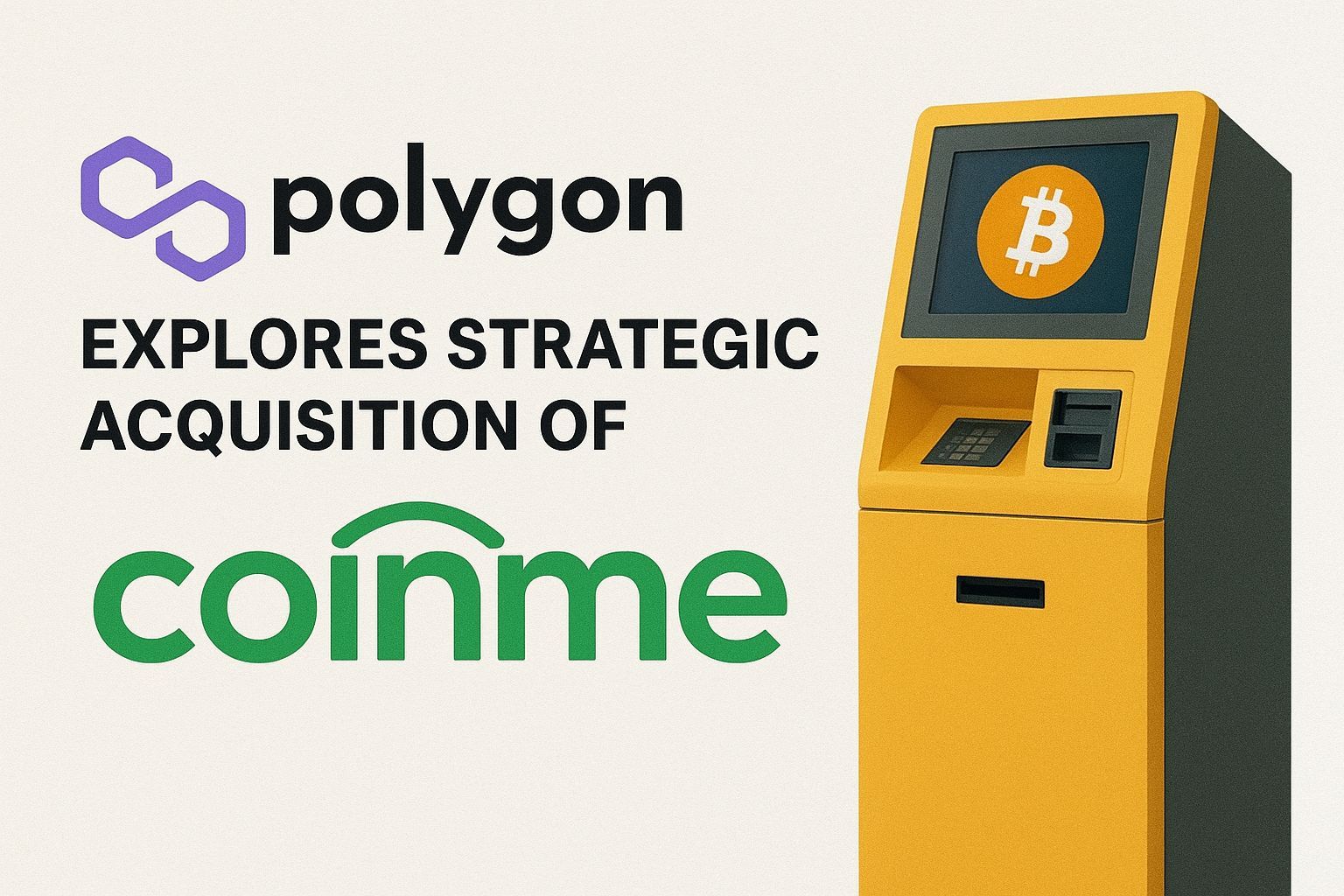
“From QR Codes to Corner Stores”: Why Polygon Even Cares About a Bitcoin Kiosk Company
Polygon explores strategic acquisition of Bitcoin kiosk leader Coinme, and that’s not just another headline in the “L2 buys something” news cycle - it’s a pretty loud signal about where on-chain money is headed and how Polygon wants to own the rails from app to ATM.[1][2][4] You’re talking a reported $100M-$125M deal, thousands of Bitcoin ATMs and retail touchpoints across the U.S., and a clear attempt to fuse Polygon’s Open Money Stack vision with real-world cash flows.[1][2][3][4]
Key Takeaways - Why This Coinme Deal Actually Matters
- Deal size: Polygon is reportedly close to acquiring Coinme for $100-$125 million, advised by Architect Partners, in a still non-public stage of negotiations.[1][2][3][6]
- Infra grab: Coinme runs one of the largest Bitcoin ATM networks in the U.S., with coverage across ~49 states and thousands of kiosks in mainstream retail locations.[2][3][4]
- Strategy fit: This plugs directly into Polygon’s Open Money Stack plan - a modular framework to bridge fiat ↔ on-chain payments and make Polygon a “full stack” money infra layer.[2][4]
- Token impact: News of the Open Money Stack plus the Coinme acquisition chatter helped push POL up ~15-20%, with daily burns around 1M POL and a projected 3.5% supply burn in 2026, turning it structurally deflationary if the pace holds.[2][4]
- Reg risk: Coinme has had regulatory issues in Washington State, including an order to repay over $8M to customers and face possible fines and license actions - Polygon isn’t just buying ATMs, it’s inheriting regulatory baggage.[1]
Subscribe to our Social Media for Exclusive Crypto News and Insights 24/7!
Polygon + Coinme: What’s Actually on the Table?
According to multiple market reports and exchange news desks, Polygon is “close” to finalizing a deal to acquire U.S. Bitcoin ATM operator Coinme, in a transaction reportedly valued at $100-$125 million.[1][2][3][4][6] Investment bank Architect Partners is advising Polygon on the deal, which is still in a private, non-public stage.[1][3][6]
Coinme isn’t some small kiosk startup. It’s one of the earliest compliant Bitcoin ATM operators in the U.S., with its first licensed Bitcoin terminal launched back in May 2014.[3] Over the years it’s expanded to crypto access in supermarkets and other offline retail venues, supporting multiple major cryptocurrencies and making “buy BTC with cash” a literal aisle-level experience.[1][3][4]
Current coverage? Reports describe Coinme as active in about 49 U.S. states, putting it right up there among the biggest regulated crypto ATM footprints in the country.[1][3][4] That’s not just hardware. That’s embedded money transmitter licensing, KYC tooling, AML processes, and relationships with regulators and retail partners.
Polygon, for its part, is sitting on a war chest. It raised $450M in 2023 in a round led by Sequoia Capital India, explicitly framed as funding the next phase of infrastructure expansion.[1][3] So this deal isn’t some YOLO buy - it fits a theme: take the L2 from “cheap blockspace” to end‑to‑end money network, from API all the way to the physical cash-in terminal.
Honestly, that move caught a lot of people off guard. Most folks expected more DeFi, more rollups, maybe another zk acquisition. Instead, Polygon is going after ATMs and kiosks. Old-world rails. Dusty cash. It’s a very “if you can’t wait for TradFi to catch up, just buy the rails” play.
Open Money Stack + Coinme: From On-Chain Vision to Street-Level Access

Polygon recently unveiled Open Money Stack, pitched as a modular, open framework for cross-chain fiat-crypto transactions and on-chain settlement.[2][4] Think of it as:
- A set of money primitives (payments, settlement, identity, compliance) that businesses can plug into.
- Built to be interoperable rather than closed - you can adopt only the parts you want and still connect to other chains and rails.[4]
- Aiming to make on-chain payments feel as seamless as traditional card or banking flows.[4]
Polygon co-founder Sandeep Nailwal has been blunt about the vision: he’s quoted saying that “all money will move on-chain over time”, with Polygon positioning itself as the base infra for that shift.[4] The Open Money Stack is the software side of that bet.
Coinme is the hardware and licensing side.
If the acquisition closes, you suddenly have:
- 6,000+ crypto ATMs and retail endpoints plugged into an L2 stack that’s optimized for cheap, fast settlement.[2]
- A regulated front door for U.S. retail - compliance frameworks and money transmitter licenses across most states, ready to be wired into Polygon’s infra.[1][3][4]
- A realistic path to what one analysis framed as Polygon turning into a “full stack banking service” bridging TradFi and digital assets - not a bank in the strict regulatory sense, but a full-spectrum transaction stack from fiat to smart contracts.[2]
A market commentator quoted around the news put it plainly: Polygon’s rumored deal to acquire Coinme and its 6,000+ ATMs could transform the network into a “full stack banking service” spanning the gap between today’s fiat world and tomorrow’s programmable finance.[2]
Imagine this in practice:
- A user walks into a supermarket, feeds cash into a Coinme kiosk.
- Under the hood, that transaction routes through Open Money Stack components, settles in POL-based or Polygon-secured rails, and surfaces directly into a wallet or app.
- Merchants or apps can plug into those same rails to pay out loyalty, wages, or rewards, all on-chain - but the customer just sees “instant credit” from cash.
That’s the difference between a chain that’s “great for NFTs and gaming” and a chain that’s “running the pipes for day-to-day money.”
Coinme’s Regulatory Baggage: Blessing and Burden

It’s not all clean upside. Coinme has real regulatory scars - and that might be precisely why it’s attractive to Polygon.
Washington State regulators ordered Coinme to repay more than $8 million to affected customers, with the order also referencing a potential $300,000 fine, possible license revocation, and even the risk of a 10-year industry ban on Coinme and its CEO.[1]
While Coinme has kept operating in other states and continues to run kiosks, the case highlights the increasing enforcement pressure facing crypto kiosk and ATM operators in the U.S.[1]
From Polygon’s perspective, this cuts both ways:
- Risk: Polygon could inherit a target on its back - regulators are already scrutinizing kiosk operators, and attaching a large, high‑profile L2 brand to that sector guarantees more attention.
- Moat: Surviving and navigating that regulatory grind is a barrier to entry. If Coinme has already built the compliance stack, taken the hits, and still holds licenses in ~49 states, that’s a serious moat against “new ATM startup #273.”[1][3]
One could argue Polygon is effectively paying eight or nine figures not just for ATMs, but for regulatory time and scars already paid for by someone else.
POL Price Action: How the Market Priced the News

When the Open Money Stack plans and the Coinme acquisition reports hit, POL didn’t just drift up - it ripped. Analytics and news coverage cited:
- A ~15% spike in POL price, with the token trading around $0.15 as traders digested the Open Money Stack roadmap and Coinme rumors.[4]
- A broader tailwind as Bitcoin tried to bounce from its latest correction, creating a supportive macro backdrop for high‑beta L2 plays.[4]
One analysis called out that the overnight rally in Polygon’s token could be setting a new resistance target, especially as sentiment is underpinned by what they described as record-high burn rates.[2]
Here’s where it gets spicy for tokenomics fans:
- Polygon’s burn mechanics have reportedly reached around 1 million POL burned per day, driven by network activity and fees.[2]
- If that pace persists, about 3.5% of total POL supply could be burned in 2026, effectively making POL deflationary at the network level.[2]
Polygon’s CEO Sandeep Nailwal summed it up in a social comment referenced in coverage:
Polygon chain is having its S-curve moment on the fees generated.[2]
Translated:
- Activity is hitting the part of the curve where fees and burns scale faster than supply issuance.
- If adoption (like plugging in 6,000+ ATMs) sticks, POL starts looking like a scarcer productive asset, not just another L2 gas token.
You’ve seen this movie before, right?
First it’s “meh, another scaling token.”
Then real-world volume ramps, burns accelerate, suddenly everyone’s posting fee charts like it’s 2021 again.
Market Mechanics: Why an ATM Deal Can Move an L2’s Narrative
To understand why this kind of acquisition matters for market structure, you’ve got to zoom out from a single candle.
1. Narrative + Liquidity Cycles
- L2 tokens like POL typically outperform during phases when on-chain activity narratives dominate - think “real world assets”, “on-chain payments”, “L2 wars”.
- The Coinme acquisition crackles right into a hot narrative intersection:
- On-chain payments / money infra
- Real-world touchpoints
- Regulated fiat ramps
Analysts highlighted that the combination of Open Money Stack and the Coinme deal “buoyed bulls” and strengthened the view of Polygon as the future of on-chain money, which helped cement the token’s short-term upside reaction.[4]
2. Dominance & Capital Rotation
While the sources don’t spell out Bitcoin or ETH dominance charts, the behavior is textbook:
- Bitcoin attempts a bounce off local lows, freeing up some risk appetite.[4]
- Capital rotates into higher beta assets linked to fresh catalysts.
- Polygon, armed with a “we’re buying ATMs and building money rails” story, becomes an obvious rotation candidate.
The whales ain’t sleeping, fam. They’re rotating.
3. Fee Curves, Burns, and Sustainable Pumps
The 1M POL daily burn and projected 3.5% annualized supply reduction for 2026[2] create conditions where:
- If actual usage keeps rising (and ATMs + fiat ramps add sustained transactional flow), price gains aren’t just “air.” They’re backed by net supply shrink + organic demand.
- Traders start treating POL more like a cash‑flow proxy on L2 fees than just a speculative governance token.
That’s the same mental re-rating that happened with other “fee-burning” ecosystems when volumes exploded - once users realize that more activity literally removes more tokens, rallies get stickier.
What Coinme Brings That Exchanges Don’t
You might ask: why mess with ATMs when CEXs and neobanks already offer fiat ↔ crypto funnels?
Coinme’s value prop, as highlighted in multiple reports, is physical reach + regulatory alignment:
- Kiosk Distribution: Coinme’s terminals are embedded in supermarkets and physical retail, making crypto feel like buying a money order, not opening a brokerage account.[1][3][4]
- Licensing Footprint: Coverage in ~49 U.S. states means Coinme has already ground through a massive compliance and licensing process.[1][3][4]
- Multi-asset Support: Coinme isn’t strictly “Bitcoin-only”; it supports multiple major coins, which could be progressively steered into Polygon-based assets or rails.[1][3]
For Polygon, this is more than just “we have ATMs now” bragging rights:
- It’s a data and flow layer - consistent local volumes, user behavior patterns, geo insights.
- It’s a routing vector - cash in at the kiosk, value settles on-chain via Polygon infra, then flows into DeFi, games, wallets, stablecoins, whatever.
- It’s brand presence in meatspace - Polygon’s logo literally next to cash machines and grocery aisles.
Back in 2022, there were countless stories of retail holders who bought BTC or altcoins via grocery-store kiosks, watched 50-60% drawdowns, and only then started learning about on-chain strategies and infra. That path - kiosk → centralized wallet → on-chain - could be shortened dramatically if Polygon owns both the first step (kiosk) and the rails (Open Money Stack).
Risks, Unknowns, and What a Savvy Investor Should Watch
It’s easy to get caught in the hype. “Polygon is buying Coinme, we’re all gonna make it.” Let’s slow down and zoom into the risk stack that’s evident from the reports.
1. Deal Is Not Final
Multiple outlets stress that:
- The transaction is still in a non-public stage.
- Neither Polygon nor Coinme had publicly commented at time of reporting.[1][3][6]
So as of the available information, this is not yet a closed acquisition. It’s a high-confidence negotiation leak, but not a signed and completed M&A. Deals break. Terms get slashed. Structures change (part equity, part earn-out, etc.).
2. Regulatory Overhang
Coinme’s Washington case isn’t a footnote; it’s a flashing hazard sign:[1]
- Forced restitution north of $8M.
- Potential fines and license impacts.
- Mention of possible long-term bans.
Crypto ATMs are becoming a regulatory focus area, not a forgotten corner. Polygon stepping into that arena probably accelerates scrutiny. If you’re long POL, you’re effectively long Polygon’s ability to navigate U.S. regulators while integrating a physical cash-in cash-out network.
3. Execution Load
Polygon is simultaneously:
- Migrating brand and ecosystem from MATIC to POL.
- Rolling out Open Money Stack as a major architectural and strategic pivot.[2][4]
- Rumored to be taking on a complex, regulated retail infra business with legacy issues.
That’s a lot of plates spinning. If execution slips - say, Open Money Stack doesn’t get adoption, or Coinme integration is messy and slow - the current market narrative could flip from “masterstroke” to “overreach.”
So… Is This Bullish or Just Loud?
From the sources and the way the market’s reacting, here’s the distilled picture:
- Strategically bullish: This is one of the clearest attempts by a major L2 to vertically integrate the full money stack, from software rails to physical endpoints.[1][2][3][4]
- Tokenomics-aligned: The rising burns, fee growth, and S-curve language from leadership suggest that if transaction volume from something like Coinme flows onto Polygon, POL could compound both adoption and scarcity.[2][4]
- Regulation-dependent: The U.S. kiosk/ATM sector is heavily watched, and Coinme’s history proves it. Polygon is stepping into a zone where politics, compliance, and crypto collide.[1]
A trader quoted around the price action framed it like this:
“This looks less like a marketing stunt and more like 2021’s infra land grab - except this time, they’re buying the fiat side too.”[2][4]
Imagine holding POL through a multi-year cycle where:
- Fees rise with real-world usage.
- ATMs become on-ramps not just to BTC, but to Polygon-native assets, stablecoins, and payments apps.
- The chain isn’t just competing on TPS, but on who controls the front door to on-chain money.
If that’s the game, the Coinme deal isn’t noise. It’s a tell.
Here are some concepts from this story you might want to dig into more:
- https://www.mexc.co/en-PH/news/441029
- https://www.coinspeaker.com/polygon-pol-token-surges-coinme-acquisition-burn-rate/
- https://www.kucoin.com/news/flash/polygon-near-acquisition-of-bitcoin-atm-operator-coinme-for-125m
- https://cryptonews.net/news/analytics/32251194/
- https://www.binance.com/fr-AF/square/post/01-09-2026-polygon-plans-acquisition-of-bitcoin-atm-provider-coinme-34832288207641
- https://www.coinex.com/feed/news/69605d4e7776979c5b3fac34