
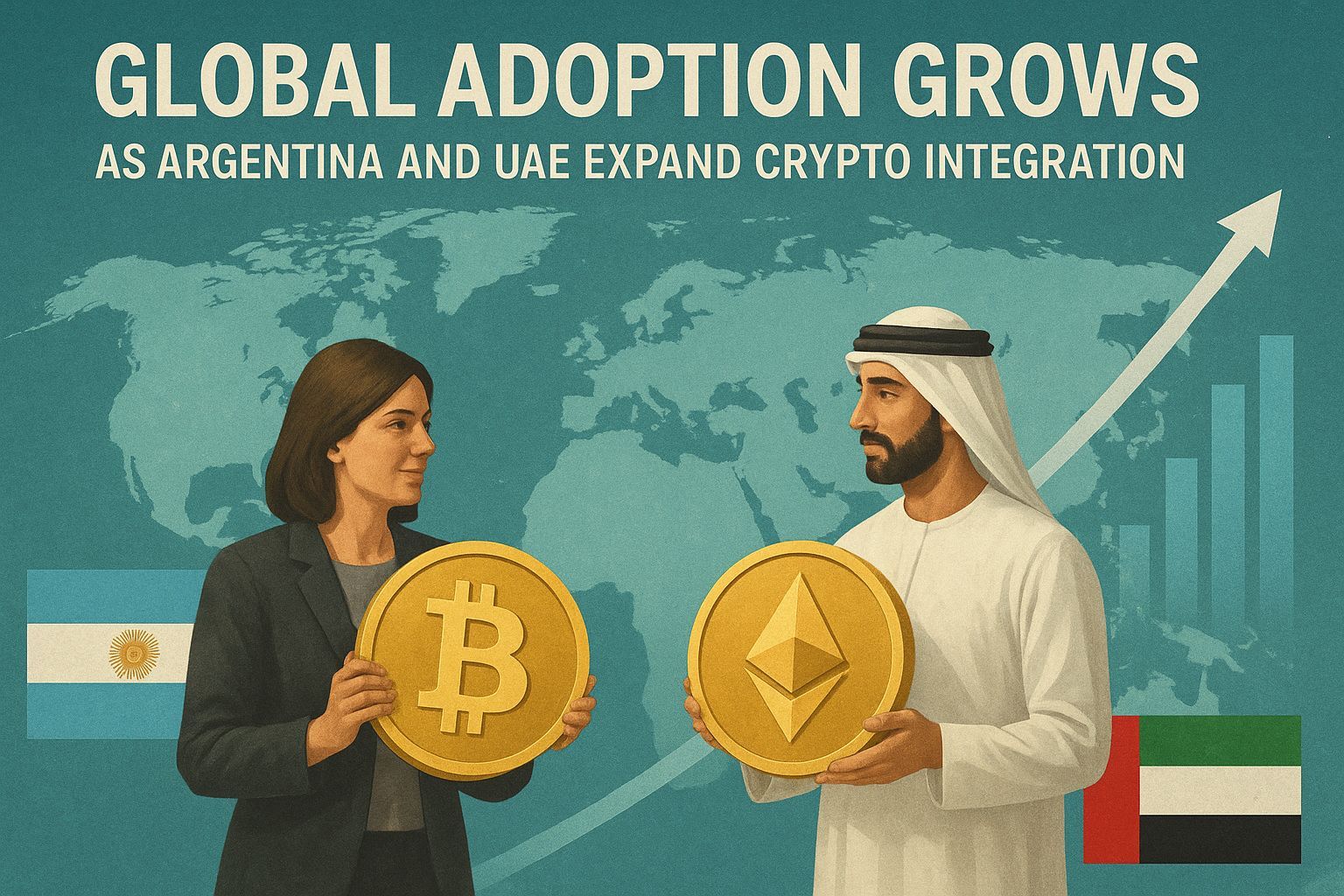
Emerging Markets Redefine Crypto’s Future: How Argentina and UAE Are Building the Infrastructure That Matters
The quiet revolution happening while everyone watches Bitcoin price charts
Here’s what’s actually happening in crypto right now, and it’s way more interesting than another bull run narrative. While the headlines obsess over BTC volatility, Argentina and the UAE are quietly constructing the regulatory and technological backbone that’ll define crypto adoption for the next decade[1][2][3]. And honestly? It’s reshaping how we should think about where this industry is headed.
Argentina’s already sitting at roughly 18.9% cryptocurrency ownership, with nearly 30% of the population owning crypto in 2024[1][8]. But here’s the plot twist-it’s not just adoption for adoption’s sake. About 60% of Argentina’s crypto transaction volume flows through stablecoins like USDT and USDC[1]. That’s not speculation. That’s utility. That’s people actually using crypto to solve real problems in an economy where inflation hits different.
Subscribe to our Social Media for Exclusive Crypto News and Insights 24/7!
The UAE? They’re playing a different game entirely. Late 2025 saw them officially launch transactions with China using mBridge, a multi-central bank CBDC platform[3]. They’re positioning themselves as the global payments hub, and they’re doing it methodically. Singapore’s right there with them, introducing dedicated stablecoin regulations and expanding CBDC trials for 2026[3].
Key Takeaways
Argentina moved from crypto chaos to structured regulation: Law 27,739 and CNV resolutions created a framework requiring crypto businesses with monthly volumes exceeding 35,000 UVA (about $29,246) to register as VASPs-and these entities must implement strict KYC, continuous transaction monitoring, and report suspicious activities within 150 days[1].
Stablecoins are the real story, not Bitcoin maximalism. Argentina and emerging markets are building payment infrastructure around them because they solve the volatility problem that actually matters to regular people[1][3].
2026 is implementation year. Regulatory frameworks introduced in 2025 are moving from sandboxes to real-world deployment. The UAE’s CBDC infrastructure and Argentina’s tokenized asset framework aren’t experiments anymore-they’re becoming operational reality[2][3].
Retail adoption in emerging markets is outpacing institutions. While wealthy countries debate, Argentina, Brazil, and Southeast Asia are already running CBDC pilots with real users[3].
Argentina: From Financial Crisis Theater to Crypto Pragmatism
Let’s be real-Argentina’s relationship with crypto didn’t start as some visionary policy. It started as desperation. When your currency implodes year after year, people start looking for alternatives. Crypto filled that void. But here’s what changed in 2025: the government actually formalized the relationship instead of fighting it[1].
President Javier Milei’s administration introduced General Resolutions 1069 and 1081 in June 2025, creating the first formal legal framework for tokenized assets[2]. These weren’t vague guidelines either. They established a regulatory sandbox environment for a one-year pilot period, with the CNV (National Securities Commission) administering the whole thing.
What does this actually mean for crypto businesses operating there? If you’re moving more than about $29,000 USD equivalent in monthly volume, you’re registering as a VASP. You’re implementing real KYC procedures. You’re monitoring transactions continuously. You’re reporting suspicious activity to the UIF (Financial Intelligence Unit) within 150 days[1]. It’s strict. It’s professional. It’s the kind of framework that makes institutional players think, “Okay, we can actually operate here.”
And the adoption numbers? Millennials aged 18-35 are driving the wave with ownership exceeding 21.9%[1]. Argentina ranks as the fourth-largest country by mobile crypto wallet users globally[1]. That’s not small-time adoption-that’s mainstream integration happening quietly while everyone’s looking elsewhere.
The government also did something genuinely smart: they made dollar adoption easier. You can open dollar savings accounts as smoothly as peso accounts. Virtual wallets work in dollars. QR code payments work in dollars. Businesses can set up automatic dollar payments[1]. They’re essentially creating a parallel financial system that crypto integrates naturally into. It’s elegant in a way most governments never achieve.
The UAE’s Global CBDC Play: When Central Banks Actually Get It
While Argentina focused on retail adoption and stablecoin infrastructure, the UAE went institutional. In late 2025, they officially launched transactions with China using mBridge-a multi-central bank CBDC platform[3]. That’s not just a technology milestone. That’s a statement about the future of cross-border payments.
The UAE announced plans to roll out a digital dirham for wholesale, retail, and cross-border use through a phased, internationally coordinated approach[3]. They’re not rushing this. They’re building it properly, which is why it’ll actually work at scale.
Singapore’s playing the same card. The Monetary Authority of Singapore introduced dedicated stablecoin regulations and expanded CBDC trials for 2026[3]. Both jurisdictions understand something that most Western regulators still haven’t grasped: digital currencies aren’t optional anymore. They’re infrastructure.
The Stablecoin Renaissance Nobody’s Talking About
Here’s what the data screams but the headlines whisper: stablecoins are winning the actual adoption war. In Argentina, 60% of crypto transaction volume flows through USDT and USDC[1]. This isn’t because people love USD. It’s because they need stability more than they need speculation.
Brazil’s Central Bank issued its first comprehensive regulatory framework for cryptoassets in November 2025, classifying certain crypto transactions as foreign-exchange operations[5]. South Korea’s at the edge of issuing won-stablecoin legislation[5]. These aren’t accidents. They’re responses to real demand.
The 2026 outlook? The “triple point” in stablecoin rollout is forming: the nexus between commercial drivers for faster payment flows along major remittance and trade corridors, clear rules on domestic and foreign stablecoins, and risk management choices from banks and corporations[5]. That’s happening now, in real-time, in emerging markets.
The Regulatory Sandbox Problem (and Why It Actually Matters)

Here’s an honest take buried in the policy data: reliance on regulatory sandboxes is becoming an industry deterrent, contrary to how these structures are intended to operate[5]. Argentina’s using a sandbox for tokenized assets. Peru’s running a retail CBDC pilot with over 100,000 users[3]. These work, but they also signal caution.
The thing is, caution isn’t always bad. Remember El Salvador’s mandatory Bitcoin acceptance? In January 2025, they removed that requirement, shifting Bitcoin to voluntary status[2]. Why? IMF conditions for a $1.4 billion loan. Sometimes pragmatism beats ideology. Sometimes the market teaches you that not everyone wants to hold volatile assets.
The Dark Side Nobody Wants to Discuss
While we’re celebrating adoption and infrastructure, there’s something genuinely alarming in the data: cryptocurrency flows to suspected human trafficking services surged 85% between 2024 and 2025, reaching hundreds of millions[7].
The payment pattern matters here. International escort services and prostitution networks operate almost exclusively using stablecoins[7]. CSAM vendors traditionally relied more heavily on bitcoin, but that’s shifting[7]. These aren’t theoretical risks. They’re operational realities that happen because stablecoins solve the exact problem we’ve been celebrating-ease of conversion, payment stability, reduced friction.
Chinese-language services operating through networks spanning mainland China, Hong Kong, Taiwan, and Southeast Asia demonstrate sophisticated payment processing and international reach, with significant flows from Brazil, the US, the UK, Spain, and Australia[7]. The blockchain’s transparency creates visibility that traditional cash never had, but it also enables infrastructure that authorities are still learning to disrupt[7].
This matters because it’s the unsexy reality of what happens when you build payment infrastructure that’s efficient, borderless, and hard to freeze. The legitimate use cases are real. The abuse cases are equally real.
What 2026 Actually Looks Like
The frameworks are set. Argentina’s tokenized asset pilot runs for a year starting June 2025. The UAE’s CBDC infrastructure is operational. Brazil’s regulatory framework is published. Attention now shifts to how these frameworks translate into concrete supervisory expectations and actual implementation[2].
Emerging markets will continue leading on digital payments. India’s UPI, Brazil’s PIX, Kenya’s M-Pesa, China’s Alipay and WeChat Pay-these platforms created the foundation for rapid CBDC exploration[3]. They’ve already solved the hard problem: getting millions of people comfortable with digital payments. CBDCs and stablecoins are just the next layer.
Retail adoption in emerging markets will mount while institutional flows accelerate via regulated ETFs and ETPs[6]. You’re looking at a bifurcated market: regular people in Argentina and Nigeria using stablecoins for actual transactions, while institutions in developed markets get exposure through regulated instruments. Both are happening. Both matter.
The Bottom Line
Argentina and the UAE aren’t just adopting crypto. They’re building the regulatory, technological, and payment infrastructure that’ll define how crypto actually integrates into global finance[1][2][3]. It’s not dramatic. It’s not a Twitter moment. But it’s the work that matters.
The stablecoin thesis is winning because it solves real problems-volatility, cross-border friction, inflation protection. The CBDC frameworks are advancing because central banks finally understand they can’t ignore digital currencies. The regulatory sandboxes exist because governments are learning to regulate without crushing innovation.
You’ve seen hype cycles before. You know how this goes. But this one? This one’s different because the adoption is happening in places where people actually need it, not just want to trade it. That’s the signal that usually precedes real, durable change.
- https://www.signzy.com/blogs/argentina-cryptocurrency-laws
- https://www.trmlabs.com/reports-and-whitepapers/global-crypto-policy-review-outlook-2025-26
- https://business.cornell.edu/article/2026/02/from-crypto-to-cbdcs/
- https://news.bitcoin.com/argentina-enters-2026-with-cryptocurrency-adoption-levels-reaching-20/
- https://www.fireblocks.com/blog/policy-changes-2025-outlook-2026
- https://stoic.ai/blog/global-crypto-adoption-a-cfos-field-guide/
- https://www.chainalysis.com/blog/crypto-human-trafficking-2026/
- https://www.triple-a.io/cryptocurrency-ownership-data






