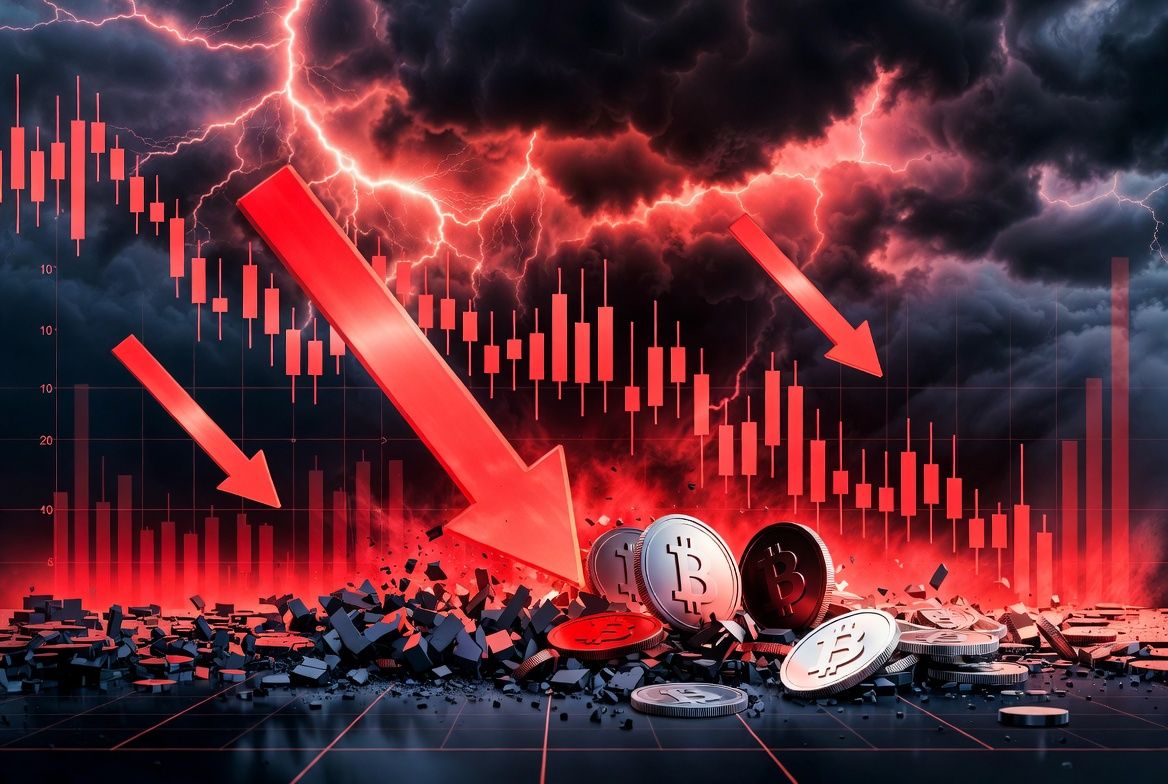
Trump’s Tariff Shock: How Policy Whiplash Hammered Crypto Markets and Left Traders Bleeding
When Presidential Trade Wars Become Crypto’s Worst Enemy
Here’s what went down: Trump’s escalating tariff announcements throughout 2025 and early 2026 triggered a cascade of liquidations across crypto markets, wiping billions from positions and creating the kind of volatility that separates hodlers from panic sellers[1][3]. Bitcoin crashed from its October 2025 peak of $126,000 down to near $65,000 by February 2026-a brutal 48% drawdown-while altcoins got absolutely hammered alongside the broader market[3]. The real kicker? The Supreme Court ruled these tariffs unconstitutional, but Trump just doubled down anyway, announcing 15% global tariffs in February 2026 despite the legal smackdown[1][3]. That’s the kind of headline that sends traders scrambling for the exit button, and the data shows exactly what happened next.
Key Takeaways
Subscribe to our Social Media for Exclusive Crypto News and Insights 24/7!
- Bitcoin plummeted 48% from its $126K October 2025 peak following Trump’s tariff announcements, with the February 2026 15% global tariff order triggering another major selloff below $65,000[1][3]
- Retail traders got caught holding the bag when April 2025’s country-specific tariffs (60% on China, 25-40% on others) sparked peak fear and forced capitulation near market bottoms[1]
- The Supreme Court ruled the tariffs illegal, but Trump announced even steeper tariffs anyway-creating unprecedented constitutional conflict that crypto markets have rarely had to price in[1][3]
- Altcoins suffered disproportionate damage: Ethereum dropped 35% in three months to $1,893, while Solana cratered roughly 42% to $79[3]
- Geopolitical and monetary policy events are now moving crypto in ways previously unseen, making traditional technical analysis less reliable[1]
The April 2025 Capitulation: When Tariff Fears Met Retail Panic
Rewind to April 2025. Trump hit major economies with country-specific tariffs-China got slapped with 60%, while Mexico, the EU, Japan, and India faced 25-40% duties[1]. Simple enough policy announcement, right? Except crypto traders aren’t just checking the news; they’re watching sentiment explode across X, Reddit, and Telegram simultaneously.
The discourse shifted immediately to full panic mode. Retail traders, already nervous about macro conditions, saw the tariff headlines and thought: “This is it. Trade war, recession incoming, time to get out.” So they did. Positions got liquidated near market lows-classic capitulation behavior where fear overwhelms any fundamental conviction[1]. Bitcoin was still grinding higher into the summer, but the psychological damage from those tariff announcements had already set in.
The pattern’s familiar to anyone who’s lived through crypto vol events: headline hits → retail fear spikes → forced selling creates cascading liquidations → smart money accumulates at panic prices. Except here, the headwinds kept coming.
October 2025: The $126K Peak and the China Tariff Bombshell
Fast forward to October 2025. Bitcoin found its all-time high of $126,000[1][3]. The bull narrative was intact-institutional adoption, inflation hedges, all that good stuff. But then Trump escalated his China rhetoric with a 100% tariff announcement[1].
That wasn’t just another policy tweak. A 100% tariff is functionally a trade embargo, and the market read it correctly. Bitcoin and the broader crypto complex entered a four-month-long price decline from that peak, shedding nearly half its value by February 2026[1][3]. The move wiped $19 billion in positions during that October shock alone-though the exact attribution between tariff news and other factors remains cloudy[3].
Here’s what’s crucial: the October peak marked the exact top before a downtrend that coincided with geopolitical escalation. Timing? Maybe coincidence. But for traders tracking positioning and conviction, watching a $126K top get followed immediately by maximum trade war rhetoric is the kind of pattern that sticks with you.
February 2026: Constitutional Crisis Meets Market Crash

Then February 2026 happened, and it got weird.
The Supreme Court ruled that Trump’s tariff actions-imposed under the International Emergency Economic Powers Act (IEEPA)-were unconstitutional[3]. Constitutional victory for free traders, right? Wrong. Trump’s response? Announce 15% global tariffs anyway[1][3].
This is the part that scrambled traditional market logic. Crypto markets had factors in policy risk before, but rarely had to factor in an active legal battle over whether the President even has the authority to do what he’s doing[1]. The dual nature-economic shock plus constitutional crisis-created reaction patterns Santiment noted as “harder to read than past tariff cycles”[1].
Bitcoin dipped below $65,000 on Sunday evening before stabilizing slightly above it by Monday[3]. Ethereum and Solana, already bleeding from the October collapse, saw further pressure. The volatility wasn’t just about tariff rates; it was about the unprecedented legal uncertainty surrounding whether these policies would even stick around.
The White House fact sheet released after the Supreme Court ruling doubled down: tariffs would “continue to be a critical tool,” and the administration claimed major trading partners representing over half of global GDP had agreed to “historic trade deals” in response[5]. Whether that’s accurate economic policy or marketing spin is a separate question, but the market read the escalation clearly: more tariffs coming, legal challenges or not.
What the Data Actually Reveals: Retail Fear as a Counter-Indicator
Here’s where it gets interesting for positioning analysis. Retail sentiment data during these tariff episodes has proven useful as a counter-indicator[1]. When fear peaks across social platforms and panic selling hits hardest, that’s often when the worst capitulation is complete-not when more downside is coming.
The timeline tells the story:
- April 2025: Tariff announcement → retail fear surge → forced liquidations near lows
- October 2025: China tariff escalation ($126K peak) → $19 billion liquidated → four-month downtrend begins
- February 2026: Supreme Court ruling + 15% tariffs announced → Bitcoin dips below $65K → stabilization signals potential bottom
Each episode followed the same behavioral pattern. The loudest fear on social media preceded the biggest moves, and positioning extremes often coincided with emotional peaks rather than fundamental weakness.
The Macro Backdrop: Why Tariffs Hit Crypto Harder Than Stocks
Traditional equities have earnings, balance sheets, and intrinsic value frameworks that can weather policy uncertainty. Crypto doesn’t. Bitcoin and alts trade largely on narrative momentum, macro sentiment, and risk appetite. When presidential policy suddenly becomes a major uncertainty vector-especially when it conflicts with constitutional law-risk appetite evaporates first, crypto follows hardest[3].
Ethereum’s 35% three-month decline and Solana’s 42% drop versus Bitcoin’s 48% total decline from the peak shows that altcoins felt the pain more acutely[3]. Smaller market cap, thinner order books, and positioning leverage meant that when retail panic hit, the exits got crowded fast.
What This Means Going Forward
The constitutional conflict between the executive and judiciary adds a layer of unpredictability that’s genuinely new for crypto markets[1]. Previous tariff cycles were “policy vs. market”; this one is “policy vs. law vs. market”-three variables instead of two.
Traders who profited through this period likely did one of two things: either they got positioned ahead of the capitulation and accumulated on panic, or they stayed flat and avoided the whipsaw entirely. The whales weren’t sleeping during these episodes; they were watching retail fear meter and stacking assets at panic prices, exactly as the pattern suggested.
The lesson? When geopolitical shocks hit and social media goes full panic mode, that’s often your signal to start paying attention to structural opportunities rather than emotional noise.
Sources:
- https://www.mexc.com/news/781708
- https://www.youtube.com/watch?v=_i3gkD1T4bY
- https://fortune.com/2026/02/23/bitcoin-stabilizes-after-tariff-whiplash/
- https://www.youtube.com/watch?v=pPk9zHhP0ug
- https://www.whitehouse.gov/fact-sheets/2026/02/fact-sheet-president-donald-j-trump-imposes-a-temporary-import-duty-to-address-fundamental-international-payment-problems/