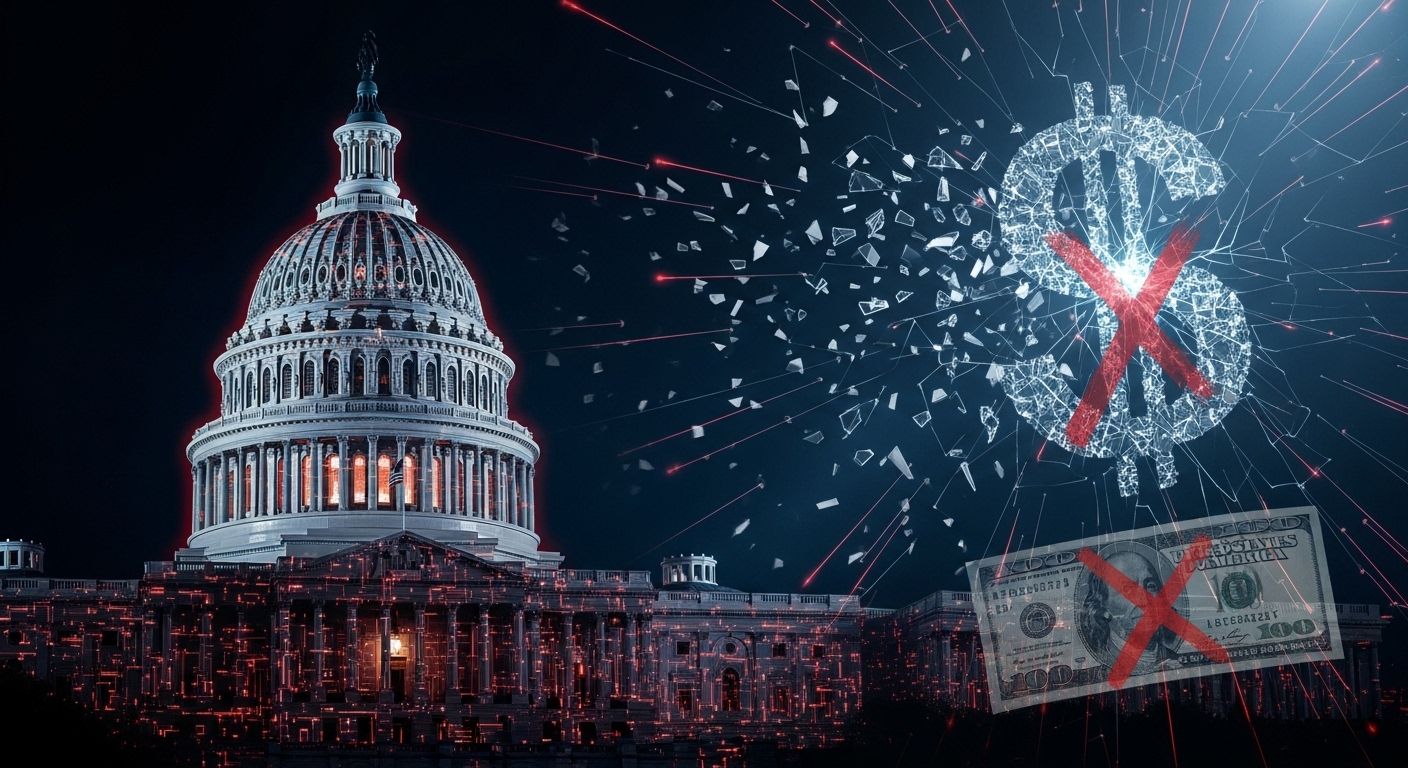
The U.S. Digital Dollar Got Killed in Congress-Here’s What Traders Need to Know
The Federal Reserve’s retail CBDC ambitions just hit a legislative brick wall, and the crypto market’s reaction tells you everything about what’s actually winning in the digital payments arms race.
Key Takeaways
• Digital Dollar Ban → Senate 89-10 Vote Through 2030 → Stablecoin Monopoly Emerging: Congress blocked Federal Reserve CBDC issuance until December 31, 2030, eliminating the government’s direct competition with private stablecoins and creating a structural advantage for USDC and Tether in the institutional settlement layer.[1]
• Stablecoin Regulatory Clarity → GENIUS Act Enacted June 2025 → Mainstream Adoption Acceleration Probable: The passage of the Guiding and Establishing National Innovation for U.S. Stablecoins (GENIUS) Act established stablecoins as non-securities, non-commodities assets under OCC oversight, legitimizing institutional participation and reducing regulatory tail risk.[2]
• Global CBDC Development → 130+ Countries Actively Developing CBDCs vs. U.S. Halt → Geopolitical Dollar Dominance Risk: President Trump’s executive order halted all U.S. retail CBDC work, positioning America as the only major economy stepping back from payments modernization while China and others maintain first-mover advantage in cross-border digital settlement.[5]
• Payments Market Growth → $1.9 Trillion (2024) to $2.4 Trillion (2029) Forecast → Traditional Banking Revenue Migration Underway: The Boston Consulting Group projects 26% payment industry expansion through 2029, with stablecoins and tokenization directly cannibalizing traditional ACH and wire transfer fee income that historically anchored bank profitability.[3]
• TradFi-DeFi Convergence → JPMorgan USD Deposit Token, Citi Token Services Live → Institutional Positioning Shift Observable: Major financial institutions including JPMorgan and Citigroup have deployed native blockchain tokens and 24/7 clearing systems, signaling irreversible institutional migration away from legacy payment rails toward tokenized settlement infrastructure.[4]
The Kill Shot: Why Congress Actually Killed the Fed’s Digital Dollar
Here’s the thing that caught most macro analysts off guard-the Senate didn’t just table the CBDC conversation. They legislatively prohibited Federal Reserve issuance through 2030 with an 89-10 bipartisan vote.[1] That’s not ambivalence. That’s a deliberate policy choice with teeth.
Subscribe to our Social Media for Exclusive Crypto News and Insights 24/7!
But rewind for context. The original premise wasn’t some shadowy crypto conspiracy. The Federal Reserve was genuinely exploring a retail CBDC-a government-issued digital dollar meant to compete directly with commercial bank deposits and, theoretically, private stablecoins. The central bank legitimacy angle was real: Fed-backed digital money would’ve been perceived as the “safest” on-chain dollar rails.
Then the political math shifted. Conservative Republicans wanted a permanent ban instead of the 2030 sunset provision. Progressive Democrats raised competitiveness concerns-that blocking CBDC development would cede digital payments leadership to China’s DCEP (Digital Currency/Electronic Payment), which is already live across Southeast Asia.[5] The result? A compromise that kills the immediate threat to stablecoin dominance while preserving the theoretical possibility of Fed action in 2031 (though nobody expects that clock to reset).
Here’s what traders should absorb: The legislative ban functionally guarantees stablecoins own the institutional dollar-equivalent settlement layer for the next four years, minimum. That’s structural scarcity in regulatory certainty. No competing Fed product. No sudden government pivot to retail CBDCs. Just private stablecoins with explicit congressional protection.
The Real Winner: Private Stablecoins Get Congressional Blessing

The ban’s carve-outs matter more than the ban itself.
Specifically, the legislation exempted “private, dollar-denominated digital currencies that are open, permissionless, and privacy-preserving.”[1] In plain English: USDC, Tether, and incoming institutional stablecoins just got a green light to operate without existential government competition.
Then came June 2025. Congress passed the GENIUS Act-a comprehensive regulatory framework that strips stablecoins of securities and commodities classification, placing them under OCC (Office of the Comptroller of the Currency) oversight alongside the Federal Deposit Insurance Corporation, Federal Reserve Board, Treasury Secretary, and state banking regulators.[2] This isn’t deregulation. It’s regulatory legitimacy.
What does that mean operationally?
Banks can now hold stablecoin reserves. The St. Cloud Financial Credit Union launched the Cloud Dollar ($CLDUSD) in December 2025 as the first U.S. credit union stablecoin after the regulatory framework provided certainty.[3] JPMorgan deployed JPM Coin on public blockchains. Citigroup integrated Citi Token Services with 24/7 USD clearing for cross-border payments.[4] These aren’t pilot projects anymore-they’re live, institutional-grade rails.
The transaction volume validates the trend. Global stablecoin transaction volumes reached $33 trillion in 2025, matching the combined throughput of traditional payment systems like ACH and Fedwire.[6] Yes, ~92% remains tied to crypto trading and on/off-ramping, but the infrastructure for broader payment adoption is now architected and operational.[4]
The Macro Picture: U.S. Payments Disruption Is Actually Happening
Here’s where the competitive angle gets interesting-and slightly terrifying if you’re a traditional banker.
The payments industry generated $1.9 trillion in annual revenue in 2024 and is projected to reach $2.4 trillion by 2029 according to Boston Consulting Group data.[3] That 26% growth isn’t distributed evenly. Banks hold the largest historical share of payments revenue, which also means they’ve got the most to lose.
Stablecoins + tokenization directly threaten three revenue pillars banks have relied on for decades:
- Wire transfer fees → Stablecoin settlement is near-instant, globally accessible, with minimal intermediaries.
- ACH float revenue → Blockchain clearing operates 24/7/365, eliminating the timing gaps banks profited from.
- Deposit spreads → If customers can hold stable-value stablecoins that yield interest (via protocols like Aave, Curve, or Lido), why hold a 0.01% savings account?
The OCC’s strategic moves reinforce this trend. They’ve granted national trust bank charters to fintech firms explicitly to “allow further interaction with digital assets and distributed ledger technology together with the benefit of federal preemption and comprehensive federal regulation.”[2] Translation: The regulatory regime is being rewritten to accelerate fintech and crypto infrastructure adoption, not contain it.
The Geopolitical Angle: Why the U.S. Just Voluntarily Stepped Back

This is the quietly alarming part.
President Trump issued an executive order halting all U.S. retail CBDC work, making the United States the only major economy to do so.[5] Meanwhile, 130+ countries are actively developing CBDCs, with Singapore and the UAE leading in regulatory clarity, and China’s DCEP already operational across cross-border settlement networks in Asia.
Why does this matter for crypto traders? Because CBDCs are fundamentally about monetary infrastructure dominance. The country (or currency bloc) that sets CBDC technical standards, interoperability protocols, and sanction architecture controls the rails. That’s geopolitical leverage.
By halting retail CBDC development while China, the EU, and the G20 push forward, the U.S. risks ceding payments infrastructure dominance even if the dollar remains the reference currency for valuations. It’s the difference between owning the platform (CBDC technical standards) versus merely being the reserve unit of account.
The Atlantic Council raises this explicitly: “In the long term, the absence of U.S. leadership and standards setting can have geopolitical consequences, especially if China and other countries maintain their first-mover advantage in the development of CBDCs.”[5]
For traders: This structural policy divergence means the U.S. is betting everything on private innovation (stablecoins, tokenization, DeFi infrastructure) to maintain dollar dominance, rather than government-backed CBDC Rails. That’s a fundamentally different game-and it concentrates pricing power in private hands, not central banks.
Market Structure: TradFi-DeFi Convergence Is No Longer Theoretical

The past 12 months saw institutional adoption shift from “experimental” to “operational infrastructure.”
JPMorgan’s USD Coin deployment on public blockchains. Citigroup’s 24/7 token clearing. Credit union stablecoins going live. These aren’t hedges against blockchain adoption-they’re explicit bets on tokenized payments replacing legacy settlement.[4]
What does this mean for positioning?
Traditional payment rails (ACH, Fedwire, Swift) are now in structural competition with blockchain-based alternatives. Banks that move early to integrate stablecoins and tokenized assets gain first-mover advantage in capturing payments flow migration. Banks that delay face deposit drain and revenue cannibalization.
For crypto markets, this creates a directional tailwind: institutional demand for stablecoins, on-chain dollar equivalents, and blockchain infrastructure becomes correlated with banking sector profitability rather than inversely correlated with it. When a JPMorgan or Citi integrates deeper into blockchain payments, they’re implicitly betting on asset class legitimacy and institutional participation.
The proposed Clarity Act signals further regulatory acceleration.[4] A “market infrastructure” bill focusing on digital asset brokers, dealers, and exchanges is expected to roll out in 2026, clarifying securities classification and reducing legal tail risk for market participants.[2]
What Got Left Behind: The CBDC Casualty
The irony is that most economists and policy experts aren’t happy about the CBDC ban.
Critics-primarily economists and several Democrats-argue that a legislative moratorium on CBDC development “limits the Fed’s capacity to modernize payment infrastructure and keep pace with international standards.”[1] There’s a real argument here: CBDCs could have served as a public good infrastructure layer, reducing systemic risk and providing a government backstop for payments.
Instead, the U.S. is doubling down on private stablecoins as the de facto digital dollar rail. That creates a different risk profile:
- Counterparty risk is higher (private companies can fail).
- Regulatory capture becomes possible (stablecoin issuers gain lobbying influence).
- Systemic contagion could spread faster if a major stablecoin loses peg or reserves.
But from a market structure perspective, it’s actually cleaner for traders: Private stablecoins are more transparent on-chain. Reserve audits are verifiable. Redemption mechanics are contractual, not policy-dependent. You get institutional-grade certainty without government opacity.
The Structural Play: What Traders Should Monitor
If you’re thinking about positioning around this shift, here are the observable asymmetries:
Stablecoin transaction volume concentration. USDC and Tether dominate institutional settlement. Monitor whether Ethereum or alternative L1/L2s show relative volume shifts-early indicators of institutional infrastructure preference before broad institutional entry.[4][6]
Bank earnings and deposit flows. Watch for quarterly bank reports showing deposit migration into stablecoin alternatives or declining ACH/wire fee revenue. This is the canary in the coal mine for how fast traditional payments actually migrate.
Regulatory clarity expansion. The Clarity Act is still in proposal stage as of early 2026.[2] Track whether it gets enacted and how aggressively the OCC moves on issuing additional national trust bank charters to crypto firms. Faster approval = accelerating institutional infrastructure buildup.
Global CBDC development parity. As China, the EU, and other G20 economies advance CBDC interoperability, watch for cross-border settlement innovations that could reduce dollar settlement dominance in non-Western trade corridors. This is slower-moving but strategically significant.
TradFi institution tokenization announcements. More JPMorgan-style blockchain deployments = institutional demand is real. Track the pace of major bank blockchain infrastructure integrations as a proxy for how seriously they’re treating tokenized payments.
The Bottom Line: Private Wins, Public Loses, Markets Expand
Congress just made a bet. Instead of a government-backed digital dollar competing with the private stablecoin market, they’ve cleared the field entirely for private innovation.
That’s bullish for stablecoins, blockchain infrastructure, and any protocol/platform that facilitates tokenized settlement. It’s bearish for traditional payment rails (ACH, Fedwire, Swift margins compress) and neutral-to-slightly-bearish for Fed independence (Congress just carved out a four-year window dictating monetary infrastructure policy).
What it isn’t is the crypto market’s loss. If anything, the legislative certainty that stablecoins will remain the institutional dollar equivalent through 2030 removes a key regulatory overhang and accelerates the convergence of traditional finance and blockchain-based settlement that’s already happening.
The real question for traders: How fast does institutional adoption actually accelerate once regulatory certainty is locked in? The plumbing is in place. The CBDC threat is gone. Banks are already deploying. It’s just a matter of how aggressively institutions move their settlement flow onto these rails.
Watch stablecoin volume, bank earnings calls, and regulatory announcements. The data’s already telling the story. Most of the market just hasn’t priced it in yet.
Sources
- https://www.mexc.com/news/918202
- https://www.clearygottlieb.com/news-and-insights/publication-listing/2026-digital-assets-regulatory-update-a-landmark-2025-but-more-developments-on-the-horizon
- https://www.fredlaw.com/alert-2026-and-fundamental-changes-to-the-u-s-payments-system
- https://www.weforum.org/stories/2026/01/digital-economy-inflection-point-what-to-expect-for-digital-assets-in-2026/
- https://www.atlanticcouncil.org/cbdctracker/
- https://www.finextra.com/the-long-read/1597/stablecoins-in-2026-how-digital-dollars-become-financial-plumbing