Has the Bitcoin Bull Run Hit a Speed Bump? Institutional Buying Drops Below Mining Supply ?
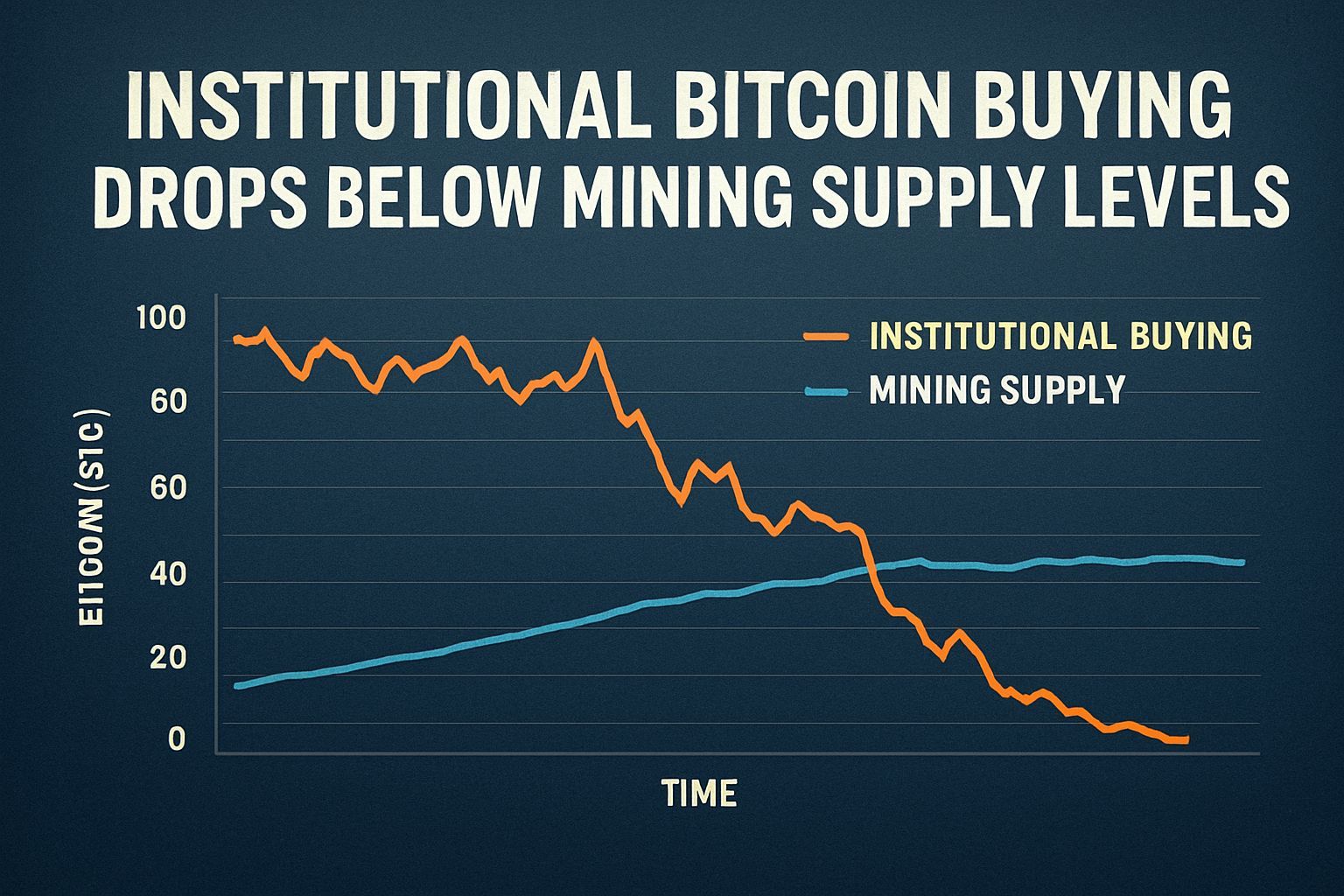
If you’ve been following Bitcoin, you know that big investors-banks, hedge funds, public companies, and even nations-have been snapping up BTC like hotcakes. For months, their collective buying power kept pace with, and often outstripped, the amount of new Bitcoin mined each day. But suddenly, something’s changed: for the first time in seven months, institutional Bitcoin buying has dipped below the daily mining supply, a shift that’s got everyone from crypto nerds to Wall Street suits raising an eyebrow[1]. This isn’t just another blip on the chart; it’s a signal flare for anyone with skin in the crypto game. So, let’s break down what’s happening, why it matters, and-most importantly-what you should be thinking about it.
## Key Takeaways ?
- **Institutional Bitcoin buying has dropped below the daily mining supply for the first time since March 2025**[1].
- **Demand for spot Bitcoin ETFs has also cooled off**, following the crypto market’s sharp dip in early October[1].
- **Despite this pullback, Bitcoin’s total supply on exchanges is at a six-year low**, suggesting that most coins aren’t being sold-they’re being tucked away in cold wallets[2].
- **Public companies, private firms, and governments still own an estimated 10% of all Bitcoin**, with some corporations, like “Strategy” (formerly MicroStrategy), holding over 640,000 BTC[2][3].
- **While short-term sentiment is cautious, long-held coins and self-custody trends are keeping sell pressure low**, and some analysts expect BTC to stay volatile but generally biased to the upside[2][5].
Subscribe to our Social Media for Exclusive Crypto News and Insights 24/7!
## What Just Happened? Institutional Buyers Hit the Brakes ?
Here’s the scoop: every day, a fresh batch of Bitcoin is mined-that’s the “supply.” For years, especially after the launch of US spot Bitcoin ETFs in early 2024, institutional investors were buying BTC faster than it was being mined. That created a real supply crunch, and many analysts point to this dynamic as a key reason for BTC’s epic bull runs.
But in early November 2025, the math flipped. According to Charles Edwards, founder of Capriole Investments, net institutional purchases have finally fallen below the daily mining issuance[1]. Why? Demand for spot ETFs softened after the October market crash[1], and some of the big “digital asset treasuries” (DATs) that had been hoarding BTC for months have run out of ammo-there are now 188 DATs holding large positions but lacking a clear business model to justify further buying[1]. Suddenly, the market’s main engine for price appreciation is running on a leaner mix.
> “There are currently 188 DATs holding large positions but lacking a business model, and the interest from institutional buyers has significantly waned.” - Charles Edwards[1]
This is a big deal, not just for price action, but for how the whole market is wired. When big money steps back, it’s like taking a lead runner out of a relay race-the pace might slow, and the rest of the field has to reassess.
## Why Does This Matter? The Big Picture Unpacked ?
Some crypto veterans might shrug: “Institutions come and go, but Bitcoin is forever.” And there’s some truth to that. But the reality is, institutional flows have become a core driver of BTC’s recent price moves, volatility, and even its reputation as a legitimate asset class.
### The ETF Effect: Not So Hot Anymore?
Spot Bitcoin ETFs changed the game by letting traditional investors buy BTC without the hassle of managing private keys. For months, these funds were vacuuming up coins, sometimes buying more than the daily mining supply, and that demand was a rocket booster for prices[1]. But now, inflows have cooled off-a trend you can actually see in the numbers, not just the vibes[1].
Does this mean the party’s over? Not necessarily. ETFs are just one channel for institutional capital. Public companies, private funds, and even governments still hold vast amounts of Bitcoin, and the trend toward “HODLing” (holding for the long term) is as strong as ever[2][3].
### Self-Custody & Supply Shock: The Hidden Bullish Signal
Here’s a twist: even as institutional buying slows, the amount of Bitcoin sitting on exchanges is at a six-year low-just 2.83 million BTC[2]. That’s a stunning drop. It means most coins aren’t being sold. They’re being locked away in cold wallets, treasuries, and corporate balance sheets. This is classic supply shock territory: less BTC on the market, less selling pressure, more room for prices to climb if demand picks back up[2].
Public companies alone now hold over 700,000 BTC, up 16% from last quarter, while major players like “Strategy” (formerly MicroStrategy) have aggressively added to their stacks, sometimes even issuing debt and new shares to do it[2]. This isn’t just speculation-it’s a strategic bet on Bitcoin as a long-term store of value and a hedge against inflation and currency debasement.
### Mining Trends: Savvy Survival Mode
Meanwhile, Bitcoin miners-the folks who actually generate new coins-aren’t panicking. In fact, many have grown up fast. They’re hedging their risk with futures and options, locking in revenues, and sometimes selling just enough mined BTC to fund operations, while keeping the rest as long-term strategic reserves[4]. For example, Marathon Digital resumed its “HODL” policy in mid-2024, buying $100 million more in BTC and vowing not to sell, while CleanSpark balanced selling some coins with maintaining a large stash[4].
This is a big change from the early days, where miners were often forced sellers-now, they’re just as much financial engineers as they are techies[4]. They’re thinking years ahead, not weeks or months.
## So, What Does This Mean for the Crypto Market? ??
Let’s get real: the crypto market is never boring. But this shift in institutional flows is arguably one of the most meaningful developments of 2025. Here’s what it could mean for you, the investor, the strategist, or the simply curious.
### Short-Term Volatility: Buckle Up
When big buyers step back, prices often get choppy. We’ve seen this before near all-time highs, where euphoria gives way to profit-taking and sentiment swings[5]. If you’re a trader, expect a bumpy ride. If you’re a long-term holder, you might barely notice-unless you obsessively check Blockfolio.
### Long-Term Outlook: Still Bullish?
Despite the dip in institutional demand, the overall structure of the market remains supportive for BTC bulls. Exchange supply is low, self-custody is high, and many big players are still accumulating, even if more quietly[2][3]. And let’s not forget: Ethereum, Solana, and other alts are enjoying their own rallies, hinting that crypto as a whole isn’t out of gas, even if Bitcoin takes a breather[2].
### Practical Tips for Navigating the Shift
Here’s the brass tacks. Whether you’re a whale, a minnow, or somewhere in between, there are ways to play this new dynamic-and not get caught flat-footed.
- **Watch ETF Flows Closely**: They’re a real-time barometer of institutional sentiment and cash movement. If ETF inflows pick back up, that’s a green light for BTC bulls[1].
- **Monitor Exchange Balances**: Fewer coins on exchanges mean less risk of sudden, severe dumps. This is a classic bullish signal, even if prices are volatile in the short term[2].
- **Think Like a Miner**: If miners are holding or hedging, not dumping, that’s a sign of confidence in longer-term value[4].
- **Keep a Long-Term Time Horizon**: Institutions might have slowed buying, but their endgame hasn’t changed-Bitcoin is still seen as a hedge and a treasury asset. Don’t let short-term noise cloud your vision.
- **Diversify-But Stay Selective**: BTC, ETH, SOL, and a few other major coins have shown resilience. Don’t chase every meme coin, but don’t miss out on real innovation, either[2].
- **Stay Informed, Not Obsessed**: The best investors are calm, strategic, and informed-not glued to charts 24/7.
## Personal Insights: What’s Really Going On Behind the Curtain? ?️
Let me step out of analyst mode for a minute and just talk like a regular person who’s been watching this movie for a while. The crypto market is full of stories, and sometimes, the real story is hidden.
Right now, some institutional players are pausing, maybe even taking a little profit after a couple of crazy years. That’s normal. Every asset class-stocks, gold, real estate-has periods where the big money steps back to catch its breath. But in crypto, especially with Bitcoin, the baseline level of “holding” is higher than ever. People aren’t just speculating; they’re building, hodling, and thinking in decades, not months.
Yes, the ETF mania has cooled[1]. Yes, some DATs are sitting on big piles of BTC with no clear use case[1]. But the real headline is how much of the supply has disappeared from exchanges, tucked away by everyone from retail whales to public companies to nation-states[2][3]. That’s not reckless speculation-that’s strategic accumulation.
And honestly, that’s why I’m still optimistic. The crypto market is growing up. We’re seeing fewer “to the moon” memes and more real financial engineering. Miners are hedging, not dumping. Companies are holding BTC, not flipping it for quarterly earnings. Even the occasional pullback-like this dip in institutional buying-feels more like a speed bump than a crash.
## Humor & Emotion: The Rollercoaster We All Signed Up For ?
Let’s be real-investing in crypto isn’t for the faint of heart. It’s part finance, part psychology, part meme culture. On days when BTC drops 10%, it feels like the sky is falling. On days when it rallies, it’s easy to forget that volatility cuts both ways.
But here’s the thing: moments like this-where the big money pauses, where the market catches its breath-are actually the most interesting. They separate the true believers from the tourists. If you’re still here, still thinking about your strategy, you’re probably in it for the long haul.
And for that, I raise a glass (or a Ledger, if you prefer). The next twist in this story is anyone’s guess. But the plot is thickening, and the best chapters may still be ahead.
## The Big Question: Are We Still Early? ?
As you process all this-the slowdown in institutional buying, the shrinking exchange supply, the rise of self-custody-ask yourself: are we still early? In 2017, people thought $20,000 was a bubble. In 2021, $69,000 felt like the top. Now, with BTC well above $100,000 and still changing hands, it’s clear that crypto is more than a fad.
But the real question is: what comes after this chapter? Will institutional money return with a vengeance? Will retail stampede back in? Will regulation or macroeconomics derail the whole thing? Or will Bitcoin’s hard cap, global reach, and immutable ledger finally cement its place as the world’s reserve asset-not just for hedge funds and tech bros, but for everyone?
That’s the story I want to see unfold. And if you’re reading this, you’re part of it.
## Main Keyphrases as Clickable HTML Links ?
- Bitcoin Institutional Buying
- Bitcoin Mining Supply
- Bitcoin ETFs Demand
## Source Links
- [1] https://www.chaincatcher.com/en/article/2216940
- [2] https://www.crowdfundinsider.com/2025/10/254196-bitcoin-btc-supply-on-digital-assets-exchanges-drops-to-6-year-low-research/
- [3] https://101blockchains.com/institutional-adoption-of-bitcoin/
- [4] https://rsmus.com/insights/industries/financial-services/investor-priorities-shifted-bitcoin-mining-operations.html
- [5] https://www.okx.com/learn/bitcoin-cycle-bear-market-drop
- [6] https://www.gurufocus.com/news/3176814/bitcoin-sees-institutional-buying-surge-as-november-begins
- [7] https://www.coindesk.com/markets/2025/10/16/bitcoin-treasury-firms-aren-t-soaking-up-btc-supply-like-they-used-to