
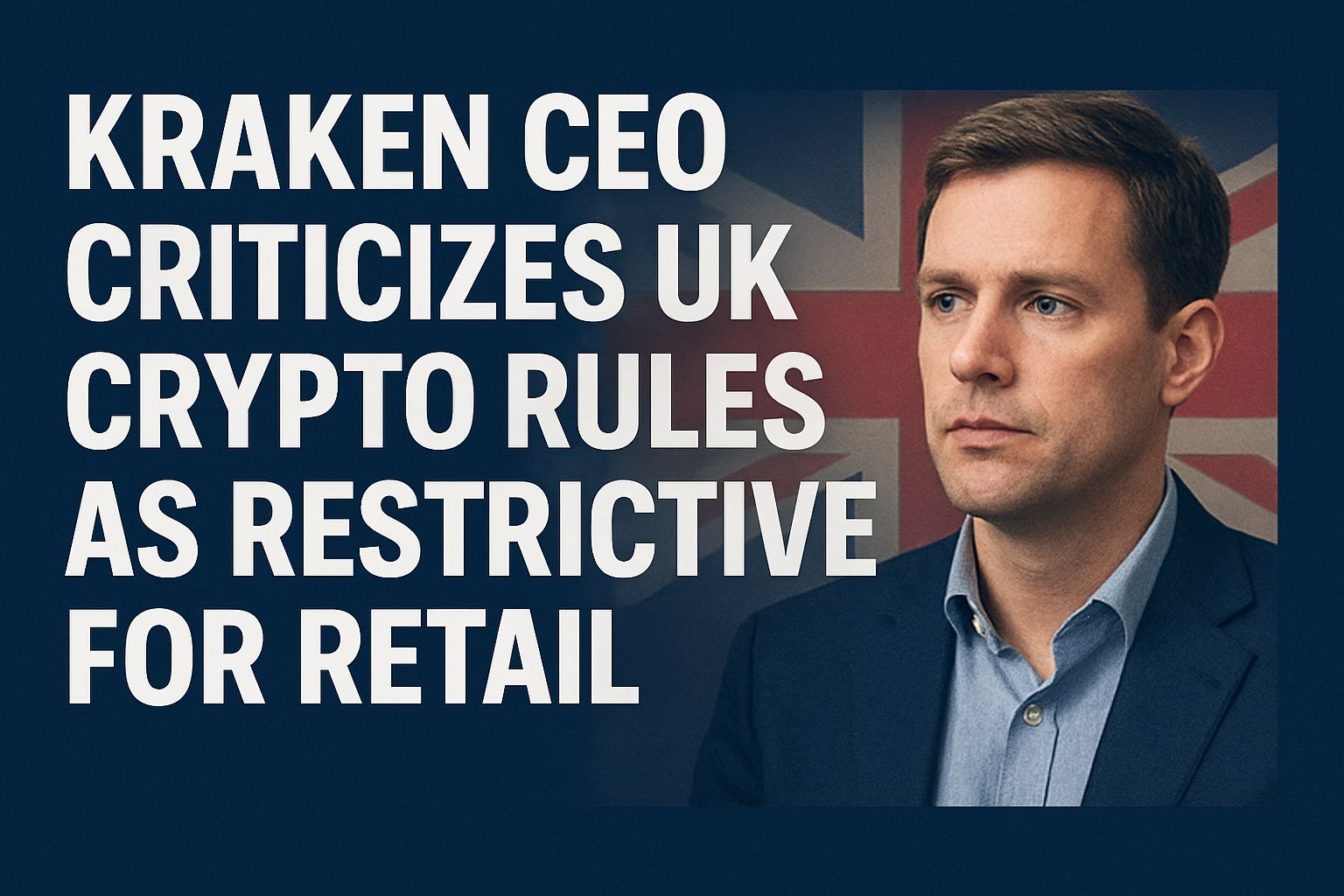
Kraken’s CEO Just Called Out UK Crypto Rules-And He’s Got a Point
? When Regulation Becomes Restriction: How the UK’s Crypto Crackdown is Quietly Shutting Out Retail Investors
Here’s the thing about crypto regulation-everyone agrees we need some of it. But there’s a massive difference between smart guardrails and cage walls that suffocate an entire market. And right now, that’s exactly what’s happening in the UK. Kraken co-CEO Arjun Sethi recently went public with something that’s been brewing beneath the surface for months: the Financial Conduct Authority’s (FCA) crypto rules aren’t protecting retail investors-they’re actively pushing them away[1][2].
Look, I get it. After the FTX collapse and all those exchange implosions, regulators wanted to make sure people understood what they were getting into. Fair enough. But when you’re forcing crypto websites to display warnings that basically scream "use this and you’re going to die" (Sethi’s words, not mine), you’re not protecting anyone-you’re just creating friction that makes the entire experience worse for people who actually want to participate[1].
Subscribe to our Social Media for Exclusive Crypto News and Insights 24/7!
Key Takeaways
- Kraken’s co-CEO argues UK regulations create excessive friction with 14-step transaction processes and cigarette-box-style warnings
- British retail investors can access only about 25% of crypto products available to US customers, missing out on DeFi yields and higher-return offerings[1][2]
- The FCA’s 2023 financial promotion rules were designed to protect investors but may be achieving the opposite effect by deterring participation
- US regulatory approach under the Trump administration contrasts sharply, creating a brain drain of capital and innovation to American exchanges
- Enforcement actions, like the £4.5 million Coinbase fine, signal the FCA’s willingness to crack down on exchanges[2]
? Understanding the Regulatory Battlefield
Let me walk you through what’s actually happening here. Back in late 2023, the FCA decided to tighten the screws on crypto marketing and financial promotion. On the surface, it sounds reasonable-require risk warnings, conduct investor suitability checks, ban incentive offers that might pump up trading volume. These aren’t unreasonable asks[1].
But here’s where it gets messy. The implementation turned into a bureaucratic nightmare. Sethi pointed out that executing a single transaction now requires navigating through what feels like 14 separate steps, complete with mandatory risk disclosures at every turn[1]. Imagine trying to buy Bitcoin on a Saturday night and getting hit with the equivalent of a pharmaceutical commercial at each stage. It’s designed to slow you down. It’s designed to make you second-guess yourself.
The irony? The FCA genuinely believes these rules help people understand both benefits and risks[1]. And sure, informed investors are important. But there’s something almost patronizing about assuming that British retail investors are too dim to handle crypto without theatrical warning labels. Compare this to the US approach, where exchanges like Kraken operate with significantly fewer friction points, and the difference becomes crystal clear[1][2].
? The Real Cost: What British Investors Are Actually Missing

Here’s where this gets personal for UK traders. According to Sethi’s analysis, the regulatory restrictions mean British customers can access approximately only 25% of the crypto products available to their American counterparts[1][2]. That’s not a minor inconvenience-that’s missing access to entire categories of yield-generating opportunities.
We’re talking about decentralized finance (DeFi) staking opportunities, high-yield lending protocols, and other strategies that sophisticated investors use to compound their returns. A trader I spoke to recently said he’d basically given up on using UK-based platforms because the products he wanted required either using a VPN (which violates terms of service) or moving his capital to US exchanges entirely[2].
Think about the market dynamics for a second. Over the past 18 months, we’ve watched DeFi lending protocols become increasingly sophisticated. Platforms like Aave have expanded their offerings dramatically, and the yield opportunities for risk-aware investors have actually become more reasonable as competition intensified. But UK residents? They’re locked out. It’s like showing up to a restaurant, sitting at the table, and only being allowed to order from a limited kids menu while the real diners next to you enjoy the full experience.
The capital drain this creates is real too. When British investors decide they’d rather move their crypto to US-based platforms, that’s money leaving the UK ecosystem entirely. The FCA might think they’re protecting capital, but they’re actually just redirecting it overseas.
? The US Contrast: Why Trump’s Crypto-Friendly Stance Matters

This is where context becomes crucial. The regulatory divergence between the UK and US isn’t accidental-it’s ideological. Under the previous administration, the US took a cautious stance not dissimilar to Britain’s. But the political landscape shifted dramatically. President Donald Trump’s administration has signaled explicit support for digital assets, creating an environment where innovation can flourish[1].
What does that mean in practical terms? It means venture capital is flowing toward US-based projects. It means exchange licensing is becoming more accessible. It means the talent and entrepreneurship that might’ve built next-gen protocols in the UK are now relocating to Miami, Austin, or New York. You’ve seen this before, right? When regulatory environments diverge sharply, capital and brains follow the path of least resistance.
Kraken, which ranks among the 15 largest exchanges globally by trading volume, has already signaled its preparation for a potential public listing as early as 2026[2]. Where’s that company going to list? The regulatory clarity and investor appetite in the US certainly makes that more attractive than building an empire under the FCA’s watchful eye.
️ The Enforcement Question: Is the FCA Actually Making Things Safer?

Here’s something worth considering: enforcement actions are ramping up. The FCA sued HTX last month for failing to comply with promotion rules[1]. Then there’s the £4.5 million fine against Coinbase in 2024 for high-risk customer onboarding violations[2]. These aren’t trivial cases.
But here’s the uncomfortable question nobody wants to ask: Are these enforcement actions actually making retail investors safer, or are they just making the user experience worse while creating a false sense of security?
Think back to previous market cycles. The exchanges that got shut down or heavily fined weren’t necessarily the ones with the most aggressive marketing. FTX had all kinds of marketing sophistication and played by the rules (or at least appeared to). The real issues were operational-commingling customer funds, bad risk management, outright fraud. Can aggressive marketing restrictions actually prevent that? Probably not.
What these rules do accomplish is make it harder for legitimate platforms to operate efficiently. They create a compliance burden that only larger exchanges with massive legal budgets can really handle. Smaller players? They either comply at massive cost or exit the market entirely. From a consumer protection standpoint, you’ve actually decreased competition, which ironically hurts retail investors by limiting their options.
? Market Mechanics: How Regulatory Friction Impacts Price Discovery
Let me get into the weeds a bit here. When you add friction to markets, you’re fundamentally changing how price discovery works. This isn’t just theoretical-you see it play out in real market data.
In markets with fewer transaction steps and lower friction (like US crypto exchanges), you get tighter bid-ask spreads and faster execution. Liquidity pools are deeper. When you add the kind of friction the FCA’s rules create, two things happen:
First, you get wider spreads because fewer retail participants means lower average trade volume. That’s a direct cost borne by every single British trader in the form of worse execution prices.
Second, you get delayed information dissemination. When an important piece of news hits the market-say, a major Bitcoin development or a regulatory announcement-US traders react faster because they can execute trades without navigating through a bureaucratic maze. This creates micro-arbitrage opportunities where US prices move first, then UK prices lag. Guess who loses money on that lag? The retail British investor.
It’s like watching a liquidation cascade in slow motion. When BTC suddenly dumps 5%, what you’re really seeing is a chain of liquidations across leverage positions. The speed at which these happen matters enormously. Traders in New York can close positions in seconds. Traders in London? They’re still filling out the third of fourteen steps.
? The Human Cost: Why This Matters Beyond Statistics
Look, I know this all sounds pretty technical, but there’s a human element here that gets lost in regulatory discussions. Imagine you’re a 30-year-old UK professional who’s been following crypto for a few years. You’re intrigued by DeFi opportunities. You’ve done your research. You’re not some naive retail investor-you understand the risks.
But then you try to actually execute your strategy on a UK platform and hit wall after wall. Fourteen steps. Warning boxes. Suitability checks that essentially gatekeep you from products you’re perfectly capable of understanding. You could move to a US exchange, but that requires converting currencies, dealing with tax reporting headaches, and honestly, it feels like you’re being punished just for being British.
So what do you do? You either give up on crypto entirely (which is what the FCA might want), or you develop a bit of resentment toward the regulatory framework that’s supposed to be protecting you. That’s not good policy. That’s not building a healthy market. That’s creating frustration that eventually boils over into either regulatory backlash or underground market activity.
? What Sethi’s Criticism Actually Reveals
When Arjun Sethi sits down with the Financial Times and starts talking about cigarette-box warnings and 14-step processes, he’s not just venting[1]. He’s articulating something that’s been brewing in the crypto industry for months: the current UK regulatory framework is fundamentally misaligned with how markets actually work.
Sethi’s been around the block. Kraken’s been operating since 2011. He’s not some reckless exchange operator arguing for zero regulation. He’s making a technical and economic argument: excessive friction creates worse outcomes for the people you’re trying to protect.
The underlying tension here is real. Regulators want certainty and risk control. Businesses want operational efficiency. These aren’t inherently incompatible, but the current framework has swung too far toward control at the expense of efficiency.
? The Bigger Picture: Regulatory Arbitrage in Action
What’s happening in the UK is a textbook example of regulatory arbitrage. When one jurisdiction tightens rules excessively, capital and talent don’t stop flowing-they redirect toward more favorable environments. We’ve seen this play out with crypto before.
When China banned cryptocurrency trading in 2017, did Bitcoin die? No. Capital moved to other exchanges in more crypto-friendly jurisdictions. The innovation didn’t stop-it just relocated. The same dynamic is playing out now with the UK versus the US.
The FCA probably isn’t prepared for the reality that their restrictive rules might actually result in fewer protected UK investors because those investors are just moving their activity somewhere else entirely. You can’t regulate your way into market participation-you can only regulate yourself out of relevance.
? What Comes Next?
Here’s the million-dollar question: Will the FCA listen to this kind of criticism? Probably not immediately. Regulatory bodies are notoriously slow to adjust course. They’re designed that way-stability and consistency matter.
But political pressure’s building. As more UK-based investors and platforms point out the comparative disadvantage they’re facing, and as the US regulatory environment becomes increasingly attractive, there’s going to be mounting pressure on policymakers to recalibrate. Not to eliminate safeguards, but to find that sweet spot between protection and functionality.
Kraken’s potential 2026 IPO might serve as a forcing function here. If a major, well-respected exchange decides to list in the US instead of the UK partly due to regulatory concerns, that sends a powerful signal[2]. Money talks louder than policy papers.
For now, though, British retail investors are caught in the middle-protected to the point of exclusion, trapped in a system that claims to have their best interests at heart while quietly shutting them out of the crypto economy.
Everything You Need to Know: UK Crypto Rules & Retail Impact
Q1: What exactly are the FCA’s 2023 financial promotion rules, and why do they matter to retail investors?
A1: The FCA introduced these rules in late 2023 to require crypto exchanges to display clear risk warnings, conduct investor suitability checks, ban profit incentives, and implement "positive friction" into the transaction process. While designed to protect retail participants, the rules create operational friction that discourages trading activity and limits product access for British investors compared to their US counterparts.
Q2: How much of the crypto market are UK investors actually locked out of due to these regulations?
A2: According to Kraken’s co-CEO, approximately 75% of crypto products available to US-based investors are inaccessible to British customers, including decentralized finance staking, lending protocols, and higher-yield opportunities. This significant product gap creates both economic disadvantage and market inefficiency for UK retail traders.
Q3: What’s the difference between the UK and US regulatory approaches to crypto, and why does it matter?
A3: The UK takes a more restrictive approach focused on risk warnings and friction, while the US under the Trump administration has signaled support for crypto innovation with fewer operational barriers. This divergence creates incentives for capital, talent, and exchanges to relocate to the US, potentially weakening the UK’s position in the global crypto economy.
Q4: Could these UK rules actually be making retail investors less safe rather than more safe?
A4: Paradoxically, excessive friction and product restrictions may harm retail investors by driving them toward unregulated alternatives, limiting market competition through stricter compliance barriers that only large exchanges can afford, and creating wider bid-ask spreads due to reduced trading volume and liquidity.
Q5: Is Kraken planning to leave the UK market entirely?
A5: Kraken hasn’t announced an exit, but the company is preparing for a potential 2026 IPO, likely targeting US markets where regulatory conditions are more favorable. The platform’s criticisms suggest mounting pressure on UK-based operations due to compliance costs and competitive disadvantage.
Q6: What can UK investors do if they want access to the same crypto products as US investors?
A6: While moving to US-based exchanges involves currency conversion and additional tax reporting complexity, it remains an option for investors seeking unrestricted product access. Alternatively, UK investors can advocate for regulatory recalibration or wait for potential policy shifts as political and market pressures mount on the FCA.
Related Crypto Topics Worth Exploring
Sources Referenced
- https://www.xt.com/en/blog/post/kraken-boss-slams-uk-crypto-rules-calls-them-a-drag-on-retail-flows
- https://www.cryptotimes.io/2025/11/12/kraken-co-ceo-arjun-sethi-slams-uk-crypto-rules-as-restrictive/
- https://www.tradingview.com/news/coinpedia:b01204bbe094b:0-kraken-co-ceo-arjun-sethi-slams-uk-s-restrictive-crypto-regulations/






